Metal Sidebar

September 8th, 2005 by

What’s “On Tap” For The Future!


(click on picture to open file)

By: Michael D. Vogel

© September 8, 2005. Michael D. Vogel. All Rights Reserved 

Published in:

Radio & Records Magazine  – September 30, 2005


With much due respect and influence to Spinal Tap, here’s a list of some of the hottest new metal bands that might break through to the masses: 

Atreyu (Victory Records)

In 2002, Atreyu exploded out of Southern California grabbing the attention of a wide spectrum of music fans by demolishing the barriers between rock, melodic hardcore and metal, crafting a sound much closer to Agnostic Front or Hatebreed. The band released their debut album, Suicide Notes and Butterfly Kisses, which has already scanned 90,000 units and shows no signs of slowing down. Their sophomore release, The Curse, was produced by GGGarth, The band’s original, unique music, with detuned guitars matched by pounding drums and acidic vocals, hit like a lightning bolt in hard music circles. Atreyu’s brand of Orange Country edgy hard rock, the support of Active Rock radio and a summer Ozzfest Tour, are energizing audiences and helping to redefine the hardcore sound Southern California is known for.

Line-Up:                                                                                   Origin:

Dan Jacobs – Lead & Rhythm Guitar                             Orange County, CA

Travis Miguel – Rhythm & Lead Guitar

Brandon Saller – Drums, Vocals & Percussion

Marc McKnight – Bass & Backing Vocals

Alex Varkatzas – Lead Vocals

About The Current CD:

The sophomore release from Atreyu, The Curse, is their second studio album.

Discography:

The Curse (Victory, 2004) 

Suicide Notes and Butterfly Kisses (Victory, 2002)

Visions EP (Independent, 1999)                            

Produced By:

GGGarth

Label:

Victory Records

Website:

www.atreyurock.com

Brand New Sin (Century Media)

Hailed by All Music Guide as “an example of everything right about hard rock,” this Syracuse-based band to hard-rock radio with a monstrous sophomore release that is sure to garner the attention and respect they truly deserve. Recipe For Disaster, the first for Century Media Records, features 13 tracks of pure hard rockin’ intensity mixed with undeniable catchy choruses and sheer aggression. The Southern-influenced hard rock quintet first burst upon the scene in 2002 with their self-titled debut album, garnering acclaim from such mainstream outlets as Billboard and Guitar One. The group went on to earn a devoted legion of fans through relentless touring with a wide array of artists, including Black Label Society, Motorhead, and Slayer. Their new album, Recipe For Disaster, incorporates a variety of metal and hard rock influences ranging from Black Sabbath, and Guns N’ Roses to Pantera and Metallica, while traces of Lynyrd Skynyrd remain evident, lending them the sort of bluesy, swampy edge they are best known for. Although they have plenty of ’70s and ’80s influences, the band maintains their hard-core influences keeping them extremely relevant to the 21st century alternative metal scene.

Line-Up:                                                                                   Origin:

Joe Altier  – Vocals                                                                Syracuse, NY

Kris Wiechmann – Guitar

Kenny Dunham – Guitar

Chuck Kahl – Bass

Kevin Dean – Drums

About The Current CD:

With their self-titled debut re-released by Century Media, Recipe For Disaster is the second full-length release, and first true release on the label.

Discography:

Recipe For Disaster (Century Media, 2005)

Brand New Sin (Now Or Never, 2002)                  

Produced By:

Brand New Sin and Pete Walker

Label:

Century Media 

Website:

www.brandnewsin.com

Iced Earth (Steamhammer/SPV Records)

Music trends flow like water and Florida’s Iced Earth has remained consistently committed to championing the cause of heavy metal through each and every ebb and flow. After years of rocking the masses patiently in the shadows, including countless lineup changes, IE have stayed the course, emerging as one of the powerhouses for classic American metal music. Lead by guitarist extraordinaire Jon Schaffer and vocals from the incomparable Tim “Ripper” Owens, Iced Earth’s music is often described as Iron Maiden combined with 80′s thrash metal. Lyrically the band tends to deal with theological issues such as destiny, heaven and hell, and the apocalypse. Many of the band’s recent albums have been concept albums –  The Dark Saga (comic book antihero-Spawn) Horror Show (horror movies) and The Glorious Burden (historical wars). Demons & Wizards, Schaffer’s other project (an on-going collaboration with vocalist Hansi Kursch from Blind Guardian) released the album Touched By The Crimson King in June of 2005, reaching tremendous airplay ar Metal radio. Currently Jon Schaffer is busy writing the next Iced Earth album, a double album that continues the story concept from the record Something Wicked This Way Comes.

Line-Up:                                                                                                           Origin:

Jon Schaffer − Lead & Rhythm Guitar & Backing Vocals              Tampa, FL.

Tim ‘Ripper’ Owens − Lead Vocals

Matt Barlow − backing vocals

Ralph Santolla − Lead Guitar

James MacDonough − Bass

Richard Christy − Drums

About The Current CD:

Following Tribute To The Gods, a collection of hard-rock songs that influenced the band, The Glorious Burden, the bands seventh studio album, is a concept album dealing with various points in American history, including the Declaration Of Independence, the American Revolutionary and Civil wars in addition to the first World War and the events of September 11th, 2001 on the World Trade Center in New York City.

Discography:

The Glorious Burden (SPV, 2004)

Tribute To The Gods (Century Media, 2002)

Horror Show (Century Media, 2001)

Something Wicked This Way Comes (Century Media, 1998)

The Dark Saga (Century Media, 1996)

Burnt Offerings (Century Media, 1995)

Night Of The Storm Rider (Century Media, 1992)

Iced Earth (Century Media, 1991)

Produced By:

Jim Morris & Jon Schaffer

Label:

Steamhammer/SPV

Website:

www.icedearth.com

Shadows Fall (Century Media)

With roots that hold comparisons to the technical, progressive brand of death metal centralized in Gothenburg, Sweden, and personified by bands like In Flames, Shadows Fall, from far across the ocean and on a completely different continent, actually call Massachusetts their home. After extensive touring throughout New England, Shadows Fall scored a deal with Century Media in 1999; with their first widely distributed domestic album, Of One Blood, issued in early 2000. In 2005, Shadows Fall unveiled their most aggressive morsel to date. Their 4th studio release, The War Within is a well-crafted opus challenging the hard rock community to embrace a record equally as revolutionary as the classic Master of Puppets was to Metallica’s career. It is their constant desire to evolve and triumph that earns Shadows Fall numerous accolades from the press, fans and other bands alike. The group was recently named one of Alternative Press’ Top Five Bands in Metal Today as well as voted Best New Talent by the readers of Revolver. Preceding the album’s release, the band has already toured Europe as part of the “New Wave of American Heavy Metal” tour together with Killswitch Engage, Chimaira and God Forbid and will headline the U.S. on the first ever Strhess Tour, sponsored by well-known artist Derek Hess.

Line-Up:                                                                             Origin:

Brian Fair – Vocals                                                          Springfield, Massachusetts

Jonathan Donais – Lead Guitar

Matthew Bachand – Rhythm Guitar

Paul Romanko – Bass

Jason Bittner – Drums

About The Current CD:

Their 4th studio release, The War Within is a well-crafted opus challenging the hard rock community to embrace a record equally as revolutionary as the classic Master of Puppets was to Metallica’s career.

Discography:

The War Within (Century Media, 2005)            Of One Blood (Century Media, 2000)

The Art Of Balance (Century Media, 2002)       Somber Eyes To The Sky (Lifeless, 1998)                  

Produced By:

Zeuss

Label:

Century Media

Website:

www.shadowsfall.com


Other Bands To Watch:

Bullet For My Valentine (Trustkill/Jive/ZLG)

Bullet For My Valentine is one of the most intense musical acts to come out of Wales. Drawing on the influences that inspired them, ranging from the almighty Iron Maiden to Metallica and Testament, Bullet For My Valentine doesn’t believe in re-inventing the wheel. These Welsh rockers are on a personal quest to bring the power of the riff back to the forefront of hard rock, and they’ve got the balls and the bravado to see that no one soon forgets it.  The bands debut effort, Hand Of Blood, is available now.

Line-Up:                                                                                             Origin:

Matthew Tuck – Lead Vocals & Rhythm Guitar                 Bridgend, South Wales

Michael “Padge” Padget – Lead Guitar & Backing Vocals

Jason “Jay” James – Bass & Vocals

Michael “Moose” Thomas – Drums

About The Current CD:

Similar to their first self-titled release, the Welsh quartet release their second EP, Hand Of Blood, the first on Trustkill Records.

Discography:

Hand Of Blood (Trustkill, 2005)

Bullet For My Valentine (Visible Noise, 2004)                                   

Produced By:

Colin Richardson 

Label:

Trustkill/Jive/ZLG

Website:

www.bulletformyvalentine1.com

Chimaira (Roadrunner)

Formed in 1998, the Cleveland, OH-based hardcore sextet Chimaira derives its name from a certain feared monster in Ancient Greek mythology. Signed to Roadrunner in 2001. The band unleashed their third, self-titled, album earlier this year.

Line-Up:                                                                                   Origin:

Mark Hunter – Vocals                                                           Cleveland, OH

Rob Arnold – Lead Guitar

Matt DeVries – Rhythm Guitar

Jim LaMarca – Bass

Kevin Talley – Drums

Chris Spicuzza – Electronics, Keys & Backing Vocals

About The Current CD:

Chimaira is the third full-length studio album for Roadrunner Records.

Discography:

Chimaira (Roadrunner, 2005)

The Impossibility Of Reason (Roadrunner, 2003)

Pass Out Of Existence (Roadrunner, 2001)                               

Produced By:

Ben Schigel and Mark Hunter 

Label:

Roadrunner

Website:

www.chimaira.com

Lamb Of God (Epic)

Originally known as Burn The Priest, Richmond, VA-based Lamb of God changed their name shortly after the release of the self-titled 1998 debut album. With a true D.i.Y. mentality, Lamb Of God has spent much of the past two years preaching their version of “pure American death metal” at major heavy metal festivals and small clubs alike. They are currently heading back to Europe for several concert appearances. Their latest release, Ashes Of The Wake, and the first true album release on Epic Records, comes on the heels of the re-issue of the band’s dynamic 1999 debut.

Line-Up:                                                                                   Origin:

Randy Blythe – Lead Vocals                                              Richmond, VA

Mark Morton – Lead & Rhythm Guitar

Willie Adler – Lead & Rhythm Guitar

John Campbell – Bass

Chris Adler – Drums & Percussions

About The Current CD:

Guitar World voted Ashes Of The Wake the 49th greatest Guitar Album of all Time. Aimed at the war in Iraq, the band’s fourth studio album is more political than their previous works.

Discography:

Ashes Of The Wake (Epic, 2004) 

As The Palaces Burn (Prosthetic, 2003)

New American Gospel (Metal Blade, 2000)

Burn The Priest (Legion, 1999)                                

Produced By:

Machine & Lamb of God

Label:

Epic 

Website:

www.lamb-of-god.com

Mastodon (Reprise)

Storming out of Atlanta, GA, this hardcore quartet has received rave reviews from America to Europe and has been compared to the almighty original Metallica heavy metal pounding. The bands debut EP, Lifeseblood, plus full-length albums Remission and Leviathan, were all released through Relapse Records. The band is currently in the studio working on their major-label, Reprise debut.

Line-Up:                                                                                   Origin:

Brent Hinds – Guitar & Vocals                                          Atlanta, GA

Bill Kelliher – Guitar

Troy Sanders – Bass & Vocals

Brann Dailor – Drums

About The Current CD:

A concept album based on Herman Melville’s novel Moby Dick. Band members have constantly stated that Ahab’s story is a parallel to the band’s journey towards success, fame and renown. The wave seen in the full picture of the artwork is a reflection of Hokusai’s The Great Wave off Kanagawa.

Discography:

Leviathan (Relapse, 2004) 

Remission (Relapse, 2002)

Lifesblood, (Relapse, 2001)

Produced By:

Mastodon & Matt Bayles

Label:

Reprise

Website:

www.mastodonrocks.com

Soilwork (Nuclear Blast) 

Forming in 1997, Soilwork combine an ultra-heavy death metal sound with power-groove riffs reminiscent of late-’70s, early-’80s British and European metal. Veterans of the Swedish metal scene, Soilwork recorded their first demo, In Dreams We Fall Into the Eternal, in 1997. Steelbath Suicide, the band’s debut album, was released in 1998. The attention helped land a U.S. deal with Century Media.

Line-Up:                                                                                   Origin:

Bjorn “Speed” Strid – Vocals                                             Helsingborg, Sweden

Peter Wichers – Guitar

Ola Frenning – Guitar

Ola Flink – Bass

Dirk Verbeuren – Drums

Sven Karlsson – Keys 

About The Current CD:

Stabbing The Drama is the fourth release on Nuclear Blast and sixth full-length studio album from melodic Swedish hard-core metal band. 

Discography:

Stabbing The Drama (Nuclear Blast, 2005) 

Figure Number Five (Nuclear Blast, 2003)

Natural Born Chaos (Nuclear Blast, 2002)

Predator’s Portrait (Nuclear Blast, 2001) 

The Chainheart Machine (Century Media, 2000)

Steelbath Suicide, (Century Media, 1998)

In Dreams We Fall Into the Eternal  (Independent, 1997)                              

Produced By:

Daniel Bergstrand

Label:

Nuclear Blast

Website:

www.soilwork.org

Superjoint Ritual (Sanctuary)

Want to get someone’s attention? There’s nothing like a swift kick to the stomach, except maybe a right hook to the face. This one-two combo is exactly what you’d expect and is delivered from Superjoint Ritual. Accordingly, the members of Superjoint Ritual approached the writing and recording of their debut (and subsequent follow-up albums) with “the perfect 15-year-old mentality of having everything loud, everything on 10, getting loaded, and letting whatever happens, happen,” guitarist Jimmy Bower has publicly stated. Forming in the ‘90’s, it wasn’t until the disbanding of Anselmo’s ‘other band-Pantera’, that SJR was able to record any music. Produced by former Ugly Kid Joe member Dave Fortman (Eyehategod, Soilent Green), the end result was the 2002 debut release Use Once and Destroy, showing the influences of Black Flag, Celtic Frost, and Voivod, among others. The album was only a warning as it helped set the tone for the whirlwind adrenaline rush that would follow with A Lethal Dose Of American Hatred and Four Doses Of American Hatred.

Line-Up:                                                                                   Origin:

Phil Anselmo – Vocals & Guitar                                       New Orleans, LA

Jimmy Bower – Guitar

Kevin Bond – Guitar

Hank Williams III – Bass

Joe Fazzio – Drums

About The Current CD:

Four Doses Of American Hatred EP is SJR’s third release on Sanctuary Records, following the punch-in-your-face albums A Lethal Dose Of American Hatred, which saw touring bassist Hank Williams III added as a fulltime member of the band and their octane-laced debut Use Once and Destroy.

Discography:

Four Doses Of American Hatred (Sanctuary, 2004) 

A Lethal Dose Of American Hatred (Sanctuary, 2003) 

Use Once and Destroy (Sanctuary, 2002)                      

Produced By:

Dave Fortman & Superjoint Ritual 

Label:

Sanctuary

Website:

www.superjointritual.com


Extreme Retail Stories:

As I Lay Dying (Metal Blade)

You want a true word of mouth, grass-roots retail success story? Hailing from San Diego, CA, As I Lay Dying’s brand of metal-hardcore is kickin’ *ss and taking names at retail. Their debut album on Metal Blade, Frail Words Collapse has scanned more than 140,000, followed closely by their sophomore release Shadows are Security, closing in at over 120,000 to date. That’s an average of over 1,100 units per week! And they’re doing it the old fashioned way – touring! Co-headliners on the second stage OZZFEST 2005 as well as the Cornerstone Festival (the nations largest Christian music festival) to name just a few of their live commitments. Breakout retail markets include: Los Angeles, New York, Philadelphia, San Diego, Boston and Chicago.

Line-Up:                                                                                   Origin:

Tim Lambesis – Vocals                                                         San Diego, CA

Nick Hipa – Guitar

Phil Sgrosso – Guitar, Bass & Piano

Clint Norris – Bass & Backing Vocals

Jordan Mancino – Drums

About The Current CD:

Shadows Are Security is the third album by AILD. Tim Lambesis, the band’s vocalist, and Phil Sgrosso, one of the band’s guitarists, along with Steve Russell, produced the record. The CD booklet features linear notes from vocalist Lambesis on the concept of the record as well as an inside look into its creation. 

Discography:

Shadows Are Security (Metal Blade, 2005)

Frail Words Collapse (Metal Blade, 2003) 

Beneath the Encasing of Ashes (Pluto, 2001)                                   

Produced By:

Tim Lambesis, Phil Sgrosso & Steve Russell 

Label:

Metal Blade

Website:

www.asilaydying.com 

Unearth (Metal Blade)

These guys aren’t your average boys from Beantown. These Boston natives are carving out their place in metal-hard-core. With head-bangin’ performances with Shadows Fall, Hatebreed, Damage Plan and Atreyu, Unearth is seeing the fruits of the hard-rockin’ labors. The Oncoming Storm has scanned over 105,000 to date, with a special edition release, with DVD, slated for October 18. The band is currently on the road with Dillinger Escape Plan; and an upcoming tour, starting in October with Slipknot and As I Lay Dying.

Line-Up:                                                                                   Origin:

Trevor Phipps – Vocals                                                       Winthrop, MA

Buz McGrath – Guitar

Ken Susi – Guitar & Backing Vocals

John Maggard – Bass

Mike Justian – Drums

About The Current CD:

Produced by Killswitch Engage guitarist Adam Dutkiewicz, The Oncoming Storm is the New England bands sophomore studio release.

Discography:

The Oncoming Storm (Metal Blade, 2004)

The Stings of Conscience (Eulogy, 2003)                                   

Produced By:

Adam Dutkiewicz

Label:

Metal Blade

Website:

www.unearth.tv


Major Metal Project:

Roadrunner United (Roadrunner)

Evolving from an unassuming Dutch import company into one of the worlds most innovative record labels over the past quarter-century, Roadrunner has set a high standard in the music world, both in musicianship and presentation as well as an unwavering commitment to some of the most intense music in the hard-rock and heavy metal genres. Drawing on it’s past, Roadrunner has amassed an all-star mega-group, the aptly titled Roadrunner United, for the album The All-Star Sessions marking the label’s 25th Anniversary. The full-length studio release, in stores October 11, boasts of a who’s who in the hard rock world. The album features collaborations between 56 artists from 45 of Roadrunner past and present bands.

At the heart of this creative effort are the fearsome four-some of Joey Jordison (Slipknot), Dino Cazares (Ex-Fear Factory), Robert Flynn (Machine Head) and Matt Heafy (Trivium). These four heavy weights in the hard rock community, acting as team captains, assembled as awesome team of fellow rockers to punctuate each track. In order to create the widest diversity with the project, no musician played for more than one writer/producer and each track features a different vocalist. In addition, longtime Type O Negative producer/keyboardist Josh Silver will also contribute special additional tracks to the album.

Dino Cazares, the team captain with the longest history with the label sums it up best: “Back in the day, if a record had a Roadrunner logo on it, you knew what you were getting…quality sh*t! It’s a real honor to be a part of Roadrunner.” ^m^

Line-Up:                                                                                  

Various, including – Max Cavalera, Dez Fafara & King Diamond – Vocals             

Various, including – Dino Cazares, Robert Flynn & Josh Rand – Guitar

Various, including – Mike D’Antonio, Paul Gray & Nadja Peulen – Bass

Various, including – Roy Mayorga, Joey Jordison & Johnny Kelly  – Drums

About The Current CD:

For The All-Star Sessions, four “team captains” (Joey Jordison (Slipknot), Dino Cazares (Ex-Fear Factory), Robert Flynn (Machine Head) and Matt Heafy (Trivium) were chosen to lead 57 artists from 45 past and present Roadrunner bands, and produce and oversee the album’s 18 tracks.

Discography:

All-Star Sessions (Roadrunner, 2005)                                 

Produced By:

Joey Jordison, Matt Heafy, Dino Cazares, Robb Flynn & Jason Suecof

Label:

Roadrunner

Website:

www.roadrunnerrecords.com/RRUnited


© September 8, 2005. Michael D. Vogel.  All Rights Reserved. This originally appeared on the Vogelism blog at https://www.vogelism.com authored by Michael D. Vogel. This article may be shared or reprinted as long as the entire copyright message, including the source location of this article, accompanies it.


Trik Turner

August 22nd, 2002 by


(click on picture to open file)

By: Michael D. Vogel

© August 22, 2002. Michael D. Vogel.  All Rights Reserved. 

Published in:

The Album Network magazineSeptember 6, 2002


SCENE: Phoenix, Arizona, in the early ’90s. David (DLB) Bowers is honing his studio chops, recording local hip-hop acts and listening to rock, dreaming of the day he can mix everything he knows and loves together in a project that will reflect his passions. He meets a kindred spirit in fellow MC Doug (Rid) Moore, and the dynamic vocal duo eventually hooks up with fellow Phoenicians Sean Faulkner on bass, drummer Sean Gardner and guitarists Tracy (Tre) Thorstad and Cristin Davis to form Trik Turner. DLB was kind enough to sit down and speak with Album Network Rock Radio Director Michael D. Vogel (who is also a fan and outspoken supporter of Trik Turner) about his band’s history, their “keep it real” attitude, their self-titled debut and subsequent live experiences.  

Talk about Trik Turner as a whole. Please give our readers some background on you guys and your “keep it real” philosophy–give us the rundown on that. 

David (DLB) Bowers: “’Keep it real’ is something that was really important to us. Even before Trik Turner got started, [when I] did some hip-hop production for some independent records that got released, [that was] one thing that was always important for me, personally. I think that’s why the guys in Trik Turner get along so well, because one of our main philosophies, lyrically and musically, is that we don’t try to jump on a bandwagon. Our lyrics come from a notepad that we’ve had for many years. It’s not like we sit down and say, ‘Okay, we need to write a radio song’; that’s not how we do it. It’s the everyday things that we go through, the pressures that we feel and what everybody feels in life. We’re not inventing the wheel; we’re doing the same thing everybody else is doing. We definitely didn’t want to be a band that got together and wrote a bunch of songs about our ex-girlfriends or relationships, or crying about, you know, whiney stuff. [But] everybody goes through heartaches and hard times, and it just so happens that’s what we want to focus on, especially lyrically.

“But to each his own. I respect anybody that has a chance to record and any artist that is doing his thing, no matter what they do. I will definitely respect the angle that they’re coming from. When we hooked up, it was kind of an unspoken thing; it wasn’t something set out that we tried to do to write songs. Believe it or not, on a lot of the songs on our first release, the concepts were written way before, like, Everlast came out. Way before Limp Bizkit and Kid Rock blew up. We were doing this back in the early to mid-’90s here in Phoenix. I know it might look, in the national scene that we’re trying to jump on a bandwagon, but it was something that we were already doing–it was true to us. We just got our record deal a little bit later than everybody else.”  

Listening to the record and seeing you guys live, it’s easy to tell that you have been doing this for a while. You definitely come across as seasoned veterans–you’re not Johnnies-come-lately jumping on the bandwagon. So the challenge that’s presented that you guys really embrace is substance over style; positivity over posing; confidence over cockiness. 

DLB: “When we hear the words, it makes us chuckle, because we’re not a young boy band–we’re not 18 years old. There’s not a bunch of models in this band. So when we come together and do music, we’re just doing what we feel. We didn’t actually have a game plan for the kind of songs we were going to write; they just came naturally over the years and we put it together. I’m going to be really, really honest with you–the first release was probably about 70 to 80% old demos that we did. Whether that’s a negative thing or a positive thing, so be it. Except for about three or four songs, it was a lot of old ideas. In the last year, since we got signed, we’ve grown so much–especially musically in what we’re doing. Some of the new material that we’re writing, I’m really excited about. It’s more hard-edged, more powerful, a little bit more rock. 

“By no means am I putting our first release down; we’re proud of it. We did the whole thing in three-and-a-half weeks. As standards go, it was pretty quick, and what we got out of it we’re really proud of.”

Let’s talk about the Rellim Tour, which was the initial introduction for Trik Turner to the rest of the country outside of the Phoenix area. How did that go? What did you learn from it? 

“What’s kind of funny is, before our record came out in late-February we started touring, just doing the club scene nationwide, trying to hit some bigger markets with us headlining. That went really well, and to us, that was getting our chops up. We went from being a local band that played once, twice a month to going to play every night, which obviously brought us up to the next notch as far as being tight and trying to find out what we wanted to do onstage–that helped a lot. We did that for about two months and then we did the Rellim Tour, which was awesome. The cool thing about that was the whole idea behind the tour: It was a free show: They brought in pizza for the kids, you could play games, and you hung out with the groups. They didn’t have a backstage; the backstage was the front stage. It really mixed well for who we are. Trik Turner is a band that likes to mingle with the crowd. We’re brand new and trying to make friends and trying to meet people, but more importantly, I don’t care where we are, we always want to go out and meet our fans and talk to people and sign autographs. That’s just really important for us. So the whole experience was awesome.“ 

What does Trik Turner bring to the rock/hip-hop hybrid that hasn’t already been done?

“Well, I know how I feel about it, but I don’t want to say that we’re doing this or that, because that’s up to the listeners and whatever. It’s really personal stuff. We definitely don’t come from the third person; we’re not writing fictitious stories about ex-girlfriends or relationship problems. We’re writing about stuff that we actually have gone through, for the most part. What we’re proud about is the fact that the hip-hop elements in our music were produced by [me]. It wasn’t like we had to hire an outside producer because we wanted a hip-hop sound; that was already part of the equation, along with the rock & roll. So to us, that’s important, because it’s real. It’s not like a bunch of white boys getting together in a rock garage band trying to infuse hip-hop in some rock & roll. The different elements are there, and are true, and that’s what we came out with.”  

It’s definitely one of my favorite albums of the year. After hanging out and getting to talk to everybody in the band, I was overwhelmed at the variety of influences and styles that the various members bring to Trik Turner, from turntables to indie rock to straight-up hip-hop. 

“If the individuals in the group had tried to copy or sound like something that was already very successful, I don’t think it ever would have worked. It started off with myself and Doug just doing some demos over some straight hip-hop beats and me sampling, like, acoustic guitar and stuff like that. That was the baby Trik Turner, writing songs like that, and that led into bringing Trey, the guitar player, in. At the time I worked with him washing cars at a rental car place in Phoenix. He just came to me one day and said, “I fool around on the guitar a little bit; how about we hook up?” Steve, our bass player, I’ve known for years. To make a long story short, when we all hooked up, it wasn’t like we had to overcome the different influences, it was just like, “Look, this is what I do best, so I’m gonna interject this. This is what you do….” Trey, he never listened to hip-hop before he got into this band and he probably still doesn’t. I’m sure his personal CD collection has no hip-hop in it, but you know what? That’s great, that’s fine. That’s not what we want on our album. Each individual brings a certain vibe to the table–we just write until we come up with songs that feel good. Our main thing right now is to just get out and play as much as we can. Go to markets two, three times and let people know. It’s not just about “Friends And Family”; come out and check out the show and I’m going to show you what Trik Turner is really about.” ^m^


Origin:

Phoenix, Arizona

Line-Up:                                                                                    

David (DLB) Bowers  – Vocals                                      Cristin Davis – Guitar

Doug (Rid) Moore – Vocals                                           Sean Gardner – Drums 

Tracy (Tre) Thorstad– Guitar                                      Sean Faulkner – Bass                                          

About The Current CD:

This is the bands self-titled debut release on RCA.

Discography:

Trik Turner (RCA, 2002) 

Black Seas and Brown Trees (Trik Turner, 1999)

Produced By:

Mudrock

Label:

RCA

Website:

www.trikturner.com


© August 22, 2002. Michael D. Vogel.  All Rights Reserved. This originally appeared on the Vogelism blog at https://www.vogelism.com authored by Michael D. Vogel. This article may be shared or reprinted as long as the entire copyright message, including the source location of this article, accompanies it.


Joe Bonamassa

July 12th, 2002 by

So, It’s Like That


(click on picture to open file)

By: Michael D. Vogel

© July 12, 2002. Michael D. Vogel.  All Rights Reserved. 

 Published in:

Totally Adult magazine – July 26, 2002


When it comes to defining the blues, there are several schools of thought, including the slick licks of Chicago, the soulful sounds of the Delta or the salty grooves laid down in Austin. These days, the blues are almost inescapable–it permeates rock (Led Zeppelin), folk (Ani DiFranco), jazz (John Scofield) and jam bands (Widespread Panic), as well as helping to launch all sorts of hyphenated strains. Back in the late ’40s, when Muddy Waters put his first blues band together, he set into motion a sound and style that would soon revolutionize popular music, leading to a tremendous blues movement that forged the way toward the formation of rock & roll. “The blues had a baby,” Waters once sang, “and they called it rock & roll!”

To the casual observer, blues-based rock may seem to ride the ebbs and flows of popularity throughout every decade, as defined by certain musicians or bands that manage to take the music to a whole new level. But interest shouldn’t begin with Robert Johnson and end with Stevie Ray Vaughan, and the occasional side excursion with Muddy Waters and B.B. King. There are always players bubbling up just under the surface, attracting regional and even national acclaim for their mastery of the blues. Into this arena enters Joe Bonamassa.

In a perfect world, where talent, contribution and historical significance are rewarded with fame and fortune, Bonamassa could be the next in line to inherit the riches of the universe. At the ripe age of 25, he already has nearly 15 years of playing experience to his credit, both as a solo artist and as a onetime member of the rock & roll offspring band, Bloodline. He is a true master of guitar in terms of technique, versatility, output and overall musical maturity. “I like to create moments of time with my music. I want each performance to be a stand-alone piece. That particular song can never be played that particular way ever again.”

To see Joe Bonamassa live is to really see him at his best. Onstage, he delivers chorus after chorus of soaring, twisting leads as if there was no bottom to his reservoir of melodic ideas. For his second solo album, So, It’s Like That (August 13, Medalist); Bonamassa rolls out one hot and soulful tune after another. Powered by a band that grooves, combined with his own tasteful playing and singing, Joe covers the blues music waterfront, from Austin to Memphis and all points in between, pulling it all together with a nifty solo tucked underneath that tears it up with the grit of legendary urban blues-man T-Bone Walker. This could be the blues-rock record we have all been waiting for–one where you can hear the heart of the blues soul beat loudly once again. ^m^


Vital Statistics:

Origin:                                                                         Website: 

Utica, NY                                                                     www.jbonamassa.com

Line-Up:                                                          

Joe Bonamassa – Vocals, Guitar & Mandolin              Boshra Al Saadi – Backing Vocals

Eric Czar – Bass                                                                         Curt Schneider  – Backing Vocals

Kenny Kramme – Drums                                                       Dave Bassett – Backing Vocals

Matt Wilcox – Keys

About The Current CD:

So, It’s Like That is Bonamassa’s third solo release.

Discography:

So, It’s Like That (Medalist, 2002)

A New Dawn Yesterday (Medalist, 2000)                     

Produced By:

Clif Magness

Label:

Medalist


© July 12, 2002. Michael D. Vogel.  All Rights Reserved. This originally appeared on the Vogelism blog at https://www.vogelism.com authored by Michael D. Vogel. This article may be shared or reprinted as long as the entire copyright message, including the source location of this article, accompanies it.
 

Doyle Bramhall II – Welcome

April 13th, 2001 by


(click on picture to open file) 

By: Michael D. Vogel

© April 13, 2001. Michael D. Vogel.  All Rights Reserved.    

Published in:

The Album Network magazine – April 27, 2001

Free Gotham – February 23, 2011


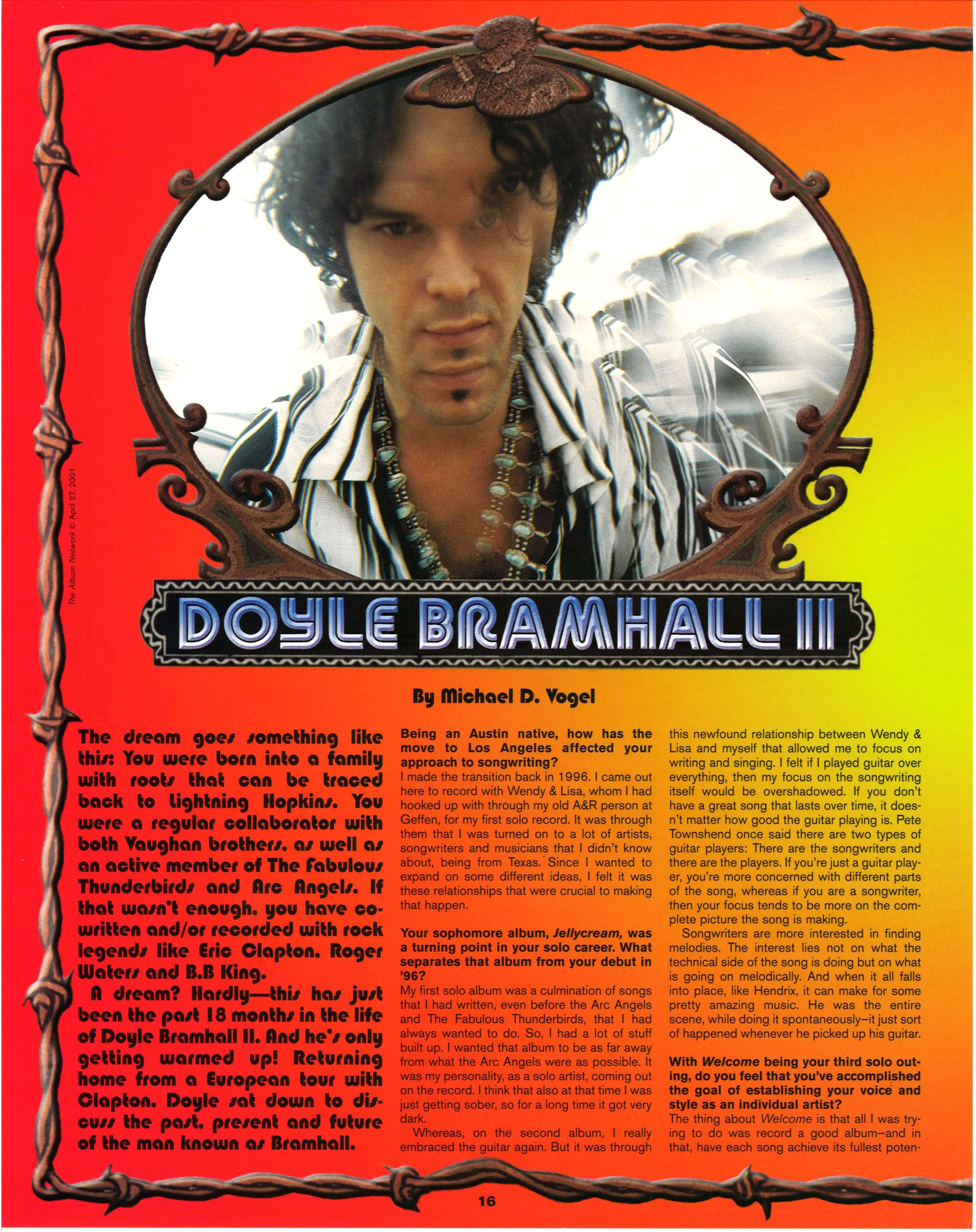
The dream goes something like this: You were born into a family with roots that can be traced back to Lightning Hopkins. You were a regular collaborator with both Vaughan brothers, as well as an active member of The Fabulous Thunderbirds and Arc Angels. If that wasn’t enough, you have co-written and/or recorded with rock legends like Eric Clapton, Roger Waters and B.B King.

A dream? Hardly–this has just been the past 18 months in the life of Doyle Bramhall II. And he’s only getting warmed up! Returning home from a European tour with Clapton, Doyle sat down to discuss the past, present and future of the man known as Bramhall.

Being an Austin native, how has the move to Los Angeles affected your approach to songwriting? 

Doyle Bramhall II: “I made the transition back in 1996. I came out here to record with Wendy & Lisa, whom I had hooked up with through my old A&R person at Geffen, for my first solo record. It was through them that I was turned on to a lot of artists, songwriters and musicians that I didn’t know about, being from Texas. Since I wanted to expand on some different ideas, I felt it was these relationships that were crucial to making that happen.”

Your sophomore album, Jellycream, was a turning point in your solo career. What separates that album from your debut in ’96? 

DB: “My first solo album was a culmination of songs that I had written, even before the Arc Angels and The Fabulous Thunderbirds, that I had always wanted to do. So, I had a lot of stuff built up. I wanted that album to be as far away from what the Arc Angels were as possible. It was my personality, as a solo artist, coming out on the record. I think that also at that time I was just getting sober, so for a long time it got very dark.

“Whereas, on the second album, I really embraced the guitar again. But it was through this newfound relationship between Wendy & Lisa and myself that allowed me to focus on writing and singing. I felt if I played guitar over everything, then my focus on the songwriting itself would be overshadowed. If you don’t have a great song that lasts over time, it doesn’t matter how good the guitar playing is. Pete Townshend once said there are two types of guitar players: There are the songwriters and there are the players. If you’re just a guitar player, you’re more concerned with different parts of the song, whereas if you are a songwriter, then your focus tends to be more on the complete picture the song is making.

“Songwriters are more interested in finding melodies. The interest lies not on what the technical side of the song is doing but on what is going on melodically. And when it all falls into place, like Hendrix, it can make for some pretty amazing music. He was the entire scene, while doing it spontaneously–it just sort of happened whenever he picked up his guitar.”

With Welcome being your third solo outing, do you feel that you’ve accomplished the goal of establishing your voice and style as an individual artist? 

“The thing about Welcome is that all I was trying to do was record a good album–and in that, have each song achieve its fullest potential. So, I went into the studio and rehearsed for seven weeks, and in that time I wrote about 25 songs. Unfortunately, the songs from Jellycream never went through that evolutionary process.

“Zeppelin and Hendrix used to play their material live long before they ever went into the studio. As a result, you can hear how slammin’ those records were. After listening to a few of those albums, I decided that I wanted that kind of sound, too. I wanted the music to evolve into that place you go when you’re playing live.”

Things have come full circle for you now with your collaboration on the Double Trouble CD. Chris Layton and Tommy Shannon refer to you as “One of the most talented people we have ever played with.” How did those special Arc Angels reunion shows come about? 

“I don’t know why, but we were getting offers to do some reunion shows. I felt [that] the band had dissolved with some things being unresolved. Basically, the way it happened was that I had such a bad drug problem, that, instead of dealing with it, I just let the drugs deteriorate me. It got to the point where I couldn’t function anymore, so I just let it fall apart and ultimately stopped showing up instead of dealing with it. But, because we are all such great friends and share a mutual level of respect for each other, the door was always left open. Even though we had some rough years together, I think that it has made our friendship even stronger.

“So the reunion was just a good thing to do. There is a real chemistry there between Charlie [Sexton], Chris, Tommy and I. So those shows were mainly a form of closure and therapy more than anything else. But, as things do, it has led to other things, like the new Double Trouble record. So I guess there’s no telling what’s going to happen in the future.”

Describe the period immediately after the release of Jellycream.

“We went out and played a lot of clubs and theaters that the Arc Angels had packed back in ’91 and ’92. It was somewhat surreal to go through that again. After touring for a few months, it didn’t look as if the record was going to take off. I always thought Jellycream was more of a musician’s record, anyway. It just didn’t seem to have the chance to appeal to a massive audience. But luckily, the record did fall into the hands of people like Eric Clapton and Roger Waters.”

What was your reaction when these legendary musicians came calling? Was it like, “Hey Doyle, Eric Clapton is on the phone for you”? 

“I’ll take you back a little before that. I got a call from Patrick Leonard, who produced Roger Waters’ Amused To Death record. Roger was looking for someone who could play guitar and sing vocals with him. They wanted a demo of ‘Comfortably Numb’ and “Money.

“I hated the idea of making a demo of ‘Money.’ The production on Dark Side Of The Moon is amazing, so that was something I just didn’t want to touch. Roger writes lyrics that are very emotionally connected. I felt that, due to my past, I could personally relate to ‘Comfortably Numb.’ It was like putting words to what I was feeling when I was drugged out and completely helpless in that situation of being a drug addict. So one day, I was hanging around my house listening to The Wall. My stereo has one of those karaoke buttons that take the lead vocals and guitar out of phase. We ended up recreating that in the studio, where my vocals and guitar replaced those of the song. The end result is something so close to what the original was, that either way, we knew we had just recorded one of the best demos ever!”

How did Eric Clapton enter the picture? 

“I was at the final gig of the Roger Waters tour. My manager had sent him a copy of the Jellycream CD. So, I called him and he said he’d love to meet and maybe play a little guitar. Maybe even talk about covering a few songs for his record with B.B King.

“I was showing him some of my songs, even though I told him that I played left-handed and upside down. This only helped to make things more confusing on how I was playing the song. So, he ended up asking me to play on the record. They ended up covering two of my songs and then Eric invited me back to help do his solo record. Eric has almost single-handedly gotten my name out there. So, I guess you could say this relationship has been very fruitful all the way around.”

Looking back, with all these feathers in your cap, this has been quite the year. Do you feel like you are past the warm-up stage now? 

“I think this is just the start. That’s why I named the record Welcome, because I felt this is the beginning of the full realization of my solo career.

“When you work with various artists, especially people like Clapton, King and Waters, certain things rub off on you. When I worked with Roger, I was taking it all in and absorbing his world. You can hear his inspirations in the song ‘Life.’ Then with Eric, his influences brought me to the main reason I did the record the way I did. After watching him play live in a big room, I knew I wanted to do my whole record the same way.

“I haven’t gotten to the point yet where I know how to approach talking about my songs and explaining them in a dissecting manner. But I know this: Although each guitar part has a purpose, it is not the focal point of the album. I think the songs are, as a whole, too strong to be overshadowed by the guitar playing, and vice-versa. Everything is equally important. My purpose is to have great songs, and if I get looked at as a great player, too, then that’s a bonus.” ^m^


Line-Up:                                                                          Origin:

Doyle Bramhall II – Vocals & Guitar                   A transplant from Austin, TX, Doyle now

J.J. Johnson – Drums                                                  calls Los Angeles, CA home

Chris Bruce – Bass

Guest Musicians:

Susannah Melvoin – Backing Vocals                 Benmont Tench – Keys

Craig Ross – Guitar

About The Current CD:

Welcome showcases the diversity of Bramhall’s talents, from his songwriting to his intense, soulful vocals and virtuoso guitar playing.

Discography:

Doyle Bramhall II

Welcome (RCA, 2001)                                     Doyle Bramhall II (Geffen 1996)

Jellycream (RCA 1999)

Double Trouble                                             Arc Angels

Been A Long Time (Tone-Cool, 2001)      Arc Angels (DGC, 1992)

Produced By:

Benmont Tench and Jim Scott 

Label:

RCA 

Website:

www.doylebramhall2nd.com


© April 13, 2001. Michael D. Vogel.  All Rights Reserved. This originally appeared on the Vogelism blog at https://www.vogelism.com, authored by Michael D. Vogel. This article may be shared or reprinted as long as this entire copyright message, including the source location of this article, accompanies it.


Chris Layton And Tommy Shannon (a.k.a. Double Trouble) – Been A Long Time! (Complete)

February 1st, 2001 by


(click on picture to open file) 

By: Michael D. Vogel 

© February 1, 2001. Michael D. Vogel.  All Rights Reserved.   

Published in:  

The Album Network magazine – April 16, 2001      

Totally Adult magazine – Februry 9, 2001 


The journey to find one’s self can often be a long and arduous task; the path to acknowledging who you are and what your contribution is can be even harder.  Such has been the voyage for drummer Chris Layton and bassist Tommy Shannon, collectively known as Double Trouble.  Stevie Ray Vaughan once said he was just a member of a band, a band called Double Trouble…and with his death came a void in the act that had revived blues/rock for a whole new generation.

After SRV’s untimely demise this premier rock and blues rhythm section embarked on a musical odyssey that witnessed them working with legends like Eric Clapton and B.B. King, as well as those destined to claim a future piece of the blues/rock throne: Layton and Shannon formed the Arc Angels with Charlie Sexton and Doyle Bramhall II, as well as the progressive blues/rock sounds of Storyville.  In each case, Chris and Tommy took a back seat in the projects, preferring to be seen only as members of the band.  But now, with the release of the first album under the Double Trouble moniker, they’re out in front–and joined by a slew of friends who’ve come along to help out on this expedition.

While preparing for their triumphant return to the Austin City Limits stage, I had the opportunity to speak with Chris and Tommy about the new album, SRV and the future of Double Trouble.

What was the impetus behind recording a new Double Trouble album? 

Tommy Shannon: “There just came a time when we started having this creative urge.  We came up with the music and part of the lyrics for five out of the 10 songs on the record.  It just started out as a guitar and a little boom-box, but I guess we got a little carried away.”

Chris Layton: “For years now, we have been doing records with other people.  So, we finally decided that it was time to do our own record.  By the time of the Arc Angels reunion last summer, we had already cut two of the tracks with Doyle [Bramhall II] in his featured spot.  It was after the reunion that we spoke to Charlie [Sexton] about working on this project with us, too.”

Was it a matter of process, getting back to writing a Double Trouble album? 

CL: “I think so; it took quite a bit of time before we were ready to do this, even though we had been asked about something like this for quite some time. Although our initial reactions were more like, ‘We probably won’t do that,’ after the Arc Angels and Storyville, it just seemed like the right thing to do. With the breakup of Storyville, we had talked about another Arc Angels album, but it didn’t really seem like it was going to pan out. Since we were already working on this idea, we decided it was time to see if we could realize it.”

Was it an issue of catharsis then, where you had to reach a point of being comfortable using the Double Trouble name again? 

CL: “The strange thing is, after Stevie’s death, we really didn’t consider ourselves as Double Trouble anymore.  But, no matter where we went or who we played with, people kept referring to us as Double Trouble.”

TS: “It’s like the people gave us that name.  So, finally we decided, yeah, we’re Double Trouble.”

Been A Long Time really showcases your songwriting talents.  Did you feel it was necessary to come out with your guns blazing? 

CL: “Our songwriting really became, not only one of our top priorities, but the actual focus of the record, not just how we play bass and drums.”

TS: “One thing we didn’t want to do was to just bring people in, plugging this person or that person into Double Trouble. But the thing that means so much to us is that we put our heart and souls into it.  And now, by putting our songs out there, our proverbial asses are on the line.”

The album title, Been A Long Time, came together in an interesting way.  How did a stargazer and an engineer help to figure in the naming of the album? 

CL: “We were kicking around all kinds of names, when a friend of ours, Mark Murray, an astrologist here in Austin, suggested the title, Been A Long Time.  At the same time our engineer, Stuart Sullivan, also suggested the same title.  After that, it seemed that the album title was pretty obvious.”

TS: “And with the first single to be ‘Rock And Roll’ and the first line of the song being, ‘Been a long time since I rock and rolled,’ it was like it was meant to be.”

From the soulful sounds of “Cry Sky” to the poppy “Skyscraper” and the down-and-dirty blues of “She’s Alright,” Been A Long Time showcases your extremely diverse sound.  What kind of choices did you go through in order to pick 10 tracks for the album? 

TS: “We envisioned a lot of the artists for the particular songs we wrote.  But it wasn’t like we told them they had to do a particular song, so if they wanted to do something else they had that option.  Fortunately, though, they seemed to like all the songs.”

CL: “We sat around for quite a while, throwing different ideas about.  And ultimately, there were quite a lot of other songs that didn’t make it on to the record, either.  But the most important part is that everybody chose the track that best suited them.  In the long run, we believe in that, simply because that always makes for the best album.”

At times, Double Trouble seems to move through music more like a jazz band than a rock group: spontaneously making music, feeding off each other to make the music flow.  With so many guests on the new album, was that possible? 

TS: “Yes.  You see, we did a lot of improvisation with Stevie, especially on his part.  He might decide to go to some totally different chord in the middle of a song, without warning, and would expect you to be there.  Since we’ve been playing together for so long, we just knew to pick up on it.

“But that’s interesting that you say that, because we listen to a lot of jazz–from Les Buchanan and Eddie Harris to John Coltrane and Miles Davis to some organ stuff from Jimmy Smith.  Stevie and I used to listen to a lot of jazz as well, especially back in the early days.  We thought how cool these players were and especially how masterful and world-class they were.  To me, in a weird way, there isn’t much difference between jazz and the blues.  It’s all about emotion and improvisation.  That’s the kind of spirit we try and emulate, of being free and living in the moment.  The music has to be very free-form.”

What was it like going into the studio as Double Trouble, without Stevie?  

CL: “To record with him was an amazing experience, but to have done a record as Double Trouble immediately after his death would have been a letdown and, in the end, probably wouldn’t have seemed like a Double Trouble record at all. So, the first thing we did after Stevie’s death was to team up with Doyle and Charlie, who are immensely talented, for the Arc Angels record. So, once again, we were in a really good band. Sadly, though, I think we had much more potential than was ever revealed on album or stage. “

TS: “I remember after Stevie’s death, for a while it didn’t matter who I played with; it all just seemed like a big letdown.  It’s something I had to deal with myself and accept the fact that Stevie was one of a kind.”

With the release of the SRV box set, which you had a major part in, the two of you had to bring up some old memories.  Tommy, I read in the liner notes how you described him as a beautiful spirit.  Can you elaborate on that? 

TS: “I’ve known Stevie since he was 14 years old, and we started playing together in bands when he was 16. Our first band was called Blackbird and then after that was Krackerjack. But just watching him grow up and the changes he went through–it’s like there’s one thing that never changed and that was this certain sense of humility and sincerity about him. He just had a beautiful spirit and the music was an expression of that. Once you really got to know him, it was no wonder it sounded so good when he played his guitar.”

There are three tracks on the box set that are from the final shows at Alpine Valley, where it’s been said the band was performing at a pinnacle level.  Looking back, did anything seem special about those shows?

TS: “Both nights were exceptionally good for us.  At that point in our career, we really felt like we were coming together as a band and really looking forward to our next record.  We were all clean and sober and working together better than ever; it was just, like, something was about to happen musically for us.  We felt like we were on the verge of breaking through to something much better than we’d ever done before.  Unfortunately, now we’ll never know.”

CL: “At the time, everyone got clean and sober in Double Trouble and we had been together for so long that it was like one big family.  So, it was more like a family crisis that needed to be resolved.”

TS: “When Stevie and I more or less hit rock bottom, it was like the other guys did, too, even though they were addicted like we were.  But they were right there supporting us and helping us all along the way.”

Where does Double Trouble go from here? 

TS: “We really want to put a band together.”

CL: “That is one of our main objectives in the New Year.  This record is already done and will accomplish things on its own whether we do certain things or not–but we realize that the best thing would be to go out and promote it.  So our main objective is to put a band together as soon as reasonably possible.  We would then do as much material off the album as we realistically could do.  It would be the jumping-off point to start a whole new adventure that could lead to a whole new record with an actual band, as opposed to a Tommy Shannon/Chris Layton project.”

Based on the mystique alone, do you think it will be hard to find a guitar player for Double Trouble? 

TS: “It’s one of those things were you’ll know when you find them.  That will determine so much of what the band will become….”

CL: “We hope that when we find these people, they can look at us and say that they found something, too.”

TS: “What it comes down to is a lot of guitar players feel that if they play with us, then they’re trying to fill Stevie’s shoes and therefore think they’ll be perceived as that–and understandably, not many guitar players want to try and do that.

“We just hope, once people listen to our record, they’ll see we’re not trying to repeat what we had with Stevie.  That would be suicide–we know, he’s a hard act to follow.  So, for Been A Long Time, we’re hoping to show people we’re coming from a totally different direction.”

CL: “Stevie was a member of Double Trouble, so when he died we thought so did the band.  So it would be inconceivable or sacrilege to say that we would just get someone else to continue with the name.  We wanted to be fresh and creative and think forward, living our lives in the future and not in the past.  That’s what spawned bands like Arc Angels and Storyville.  But as far as Double Trouble now, there is no agenda as to what the band needs to be other than a band that works well together and makes really good music.”

TS: “That’s the magic of the whole thing!” ^m^


Line-Up:                                                             Origin: 

Chris Layton – Drums                                     Austin, TX 

Tommy Shannon – Bass

Guest Musicians: 

Doyle Bramhall II – Vocals & Guitar                       Eric Johnson – Guitar 

Charlie Sexton – Vocals, Keys & Guitar)                Willie Nelson – Guitar 

Jimmie Vaughan – Vocals & Guitar                        Dr. John – Vocals & Keys 

Reese Wynans – Keys                                                     Susan Tedeschi – Vocals & Guitar 

Gordie Johnson – Guitar                                              Malford Milligan – Vocals 

Kenny Wayne Shepherd – Guitar                             Lou Ann Barton – Vocals 

Jonny Lang – Vocals & Guitar 

About The Current CD: 

Although they’ve recorded with numerous musicians (as well as releases under different band names), this is the first album issued by Tommy Shannon and Chris Layton as Double Trouble since the death of Stevie Ray Vaughan. 

Discography:  

Double Trouble                                                   Storyville  

(www.doubletroublemusic.com)          (www.myspace.com/storyvilleaustintx) 

Been A Long Time (Tone-Cool, 2001)            Dog Years (Atlantic, 1998) 

                                                                                        A Piece Of Your Soul (Atlantic, 1996) 

Arc Angels  

(http://www.arcangelsmusic.com)  

Arc Angels (DGC, 1992) 

Stevie Ray Vaughan And Double Trouble

(www.legacyrecordings.com/Stevie-Ray-Vaughan.aspx) 

In Step (Epic, 1989)                                                                   

Soul To Soul (Epic, 1985)                                                           

Couldn’t Stand The Weather (Epic, 1984) 

Texas Flood (Epic, 1983) 

Produced By: 

Various tracks produced by: Double Trouble and/or Charlie Sexton, Doyle Bramhall II and Stephan Bruton 

Label: 

Tone-Cool 

Website: 

www.doubletroublemusic.com


© February 1, 2001. Michael D. Vogel.  All Rights Reserved. This originally appeared on the Vogelism blog at https://www.vogelism.com, authored by Michael D. Vogel. This article may be shared or reprinted as long as the entire copyright message, including the source location of this article, accompanies it.