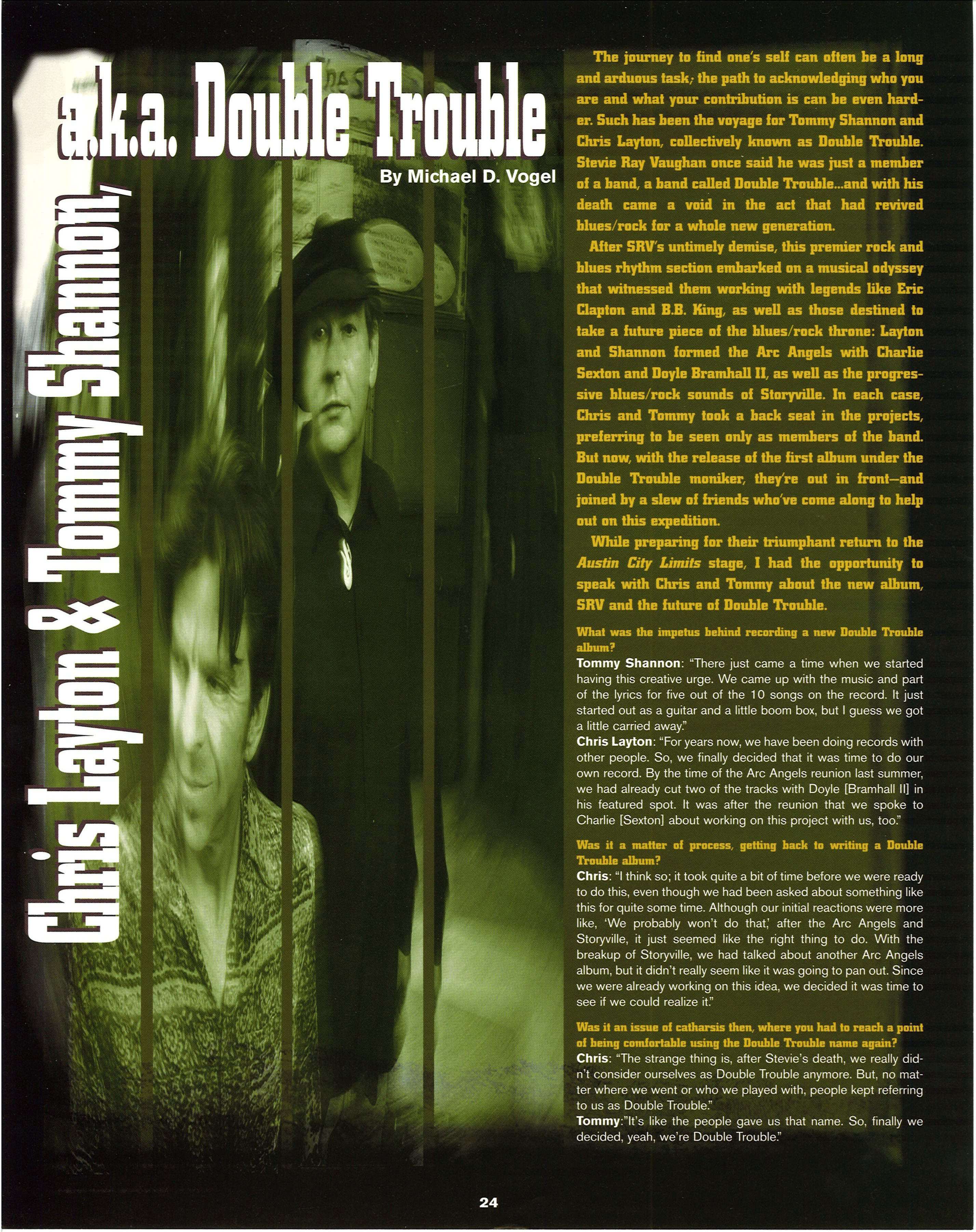
Chris Layton And Tommy Shannon (a.k.a. Double Trouble) – Been A Long Time! (Rock Edit)

February 1st, 2001 by


(click on picture to open file) 

By: Michael D. Vogel 

© February 1, 2001. Michael D. Vogel.  All Rights Reserved.  

Published in:  

The Album Network magazine – April 16, 2001      


The journey to find one’s self can often be a long and arduous task; the path to acknowledging who you are what your contribution is can be even harder. Such has been the voyage for Tommy Shannon and Chris Layton, collectively known as Double Trouble. Stevie Ray Vaughan once said he was just a member of a band, a band called Double Trouble…and with his death came a void in the act that had revived blues/rock for a whole new generation.

After SRV’s untimely demise this premier rock and blues rhythm section embarked on a musical odyssey that witnessed them working with legends like Eric Clapton and B.B. King, as well as those destined to take a future piece of the blues/rock throne: Layton and Shannon formed the Arc Angels with Charlie Sexton and Doyle Bramhall II, as well as the progressive blues/rock sounds of Storyville. In each case, Chris and Tommy took a back seat in the projects, preferring to be seen only as members of the band. But now, with the release of the first album under the Double Trouble moniker, they’re out in front–and joined by a slew of friends who’ve come along to help out on this expedition.

While preparing for their triumphant return to the Austin City Limits stage, I had the opportunity to speak with Chris and Tommy about the new album, SRV and the future of Double Trouble.

What was the impetus behind recording a new Double Trouble album?

Tommy Shannon: “There just came a time when we started having this creative urge. We came up with the music and part of the lyrics for five out of the 10 songs on the record. It just started out as a guitar and a little boom-box, but I guess we got a little carried away.”

Chris Layton: “For years now, we have been doing records with other people. So, we finally decided that it was time to do our own record. By the time of the Arc Angels reunion last summer, we had already cut two of the tracks with Doyle [Bramhall II] in his featured spot. It was after the reunion that we spoke to Charlie [Sexton] about working on this project with us, too.”

Was it a matter of process, getting back to writing a Double Trouble album?

CL: “I think so; it took quite a bit of time before we were ready to do this, even though we had been asked about something like this for quite some time. Although our initial reactions were more like, ‘We probably won’t do that,’ after the Arc Angels and Storyville, it just seemed like the right thing to do. With the breakup of Storyville, we had talked about another Arc Angels album, but it didn’t really seem like it was going to pan out. Since we were already working on this idea, we decided it was time to see if we could realize it.”

Was it an issue of catharsis then, where you had to reach a point of being comfortable using the Double Trouble name again?

CL: “The strange thing is, after Stevie’s death, we really didn’t consider ourselves as Double Trouble anymore. But, no matter where we went or who we played with, people kept referring to us as Double Trouble.”

TS: “It’s like the people gave us that name. So, finally we decided, yeah, we’re Double Trouble.”

Been A Long Time really showcases your songwriting talents. Did you feel it was necessary to come out with your guns blazing?

CL: “Our songwriting really became, not only one of our top priorities, but the actual focus of the record, not just how we play bass and drums.” 

TS: “One thing we didn’t want to do was to just bring people in, plugging this person or that person into Double Trouble. But the thing that means so much to us is that we put our heart and souls into it. And now, by putting our songs out there, our proverbial asses are on the line.”

The album title, Been A Long Time, came together in an interesting way.  How did a stargazer and an engineer help to figure in the naming of the album? 

CL: “We were kicking around all kinds of names, when a friend of ours, Mark Murray, an astrologist here in Austin, suggested the title Been A Long Time. At the same time our engineer, Stuart Sullivan, also suggested the same title. After that, it seemed that the album title was pretty obvious.”

TS: “And with the first single to be ‘Rock And Roll’ and the first line of the song being, ‘Been a long time since I rock and rolled,’ it was like it was meant to be.”

From the soulful sounds of ‘Cry Sky’ to the poppy ‘Skyscraper’ and the down-and-dirty blues of ‘She’s Alright,’ Been A Long Time showcases your extremely diverse sound. What kind of choices did you go through in order to pick 10 tracks for the album? 

TS: “We envisioned a lot of the artists for the particular songs we wrote. But it wasn’t like we told them they had to do a particular song, so if they wanted to do something else they had that option. Fortunately, though, they seemed to like all the songs.”

CL: “We sat around for quite a while, throwing different idea’s about. And ultimately, there were quite a lot of other songs that didn’t make it on to the record, either. But the most important part is that everybody chose the track that best suited them. In the long run, we believe in that, simply because that always makes for the best album.”

What was it like going into the studio as Double Trouble, without Stevie? 

CL: “To record with him was an amazing experience, but to have done a record as Double Trouble immediately after his death would have been a letdown and, in the end, probably wouldn’t have seemed like a Double Trouble record at all. So, the first thing we did after Stevie’s death was to team up with Doyle and Charlie, who are immensely talented, for the Arc Angels record. So, once again, we were in a really good band. Sadly, though, I think we had much more potential than was ever revealed on album or stage. “

TS: “I remember after Stevie’s death, for a while it didn’t matter who I played with; it all just seemed like a big letdown. It’s something I had to deal with myself and accept the fact that Stevie was one of a kind.”

With the release of the SRV box set, which you had a major part in, the two of you had to bring up some old memories. Do you find it difficult to talk about him? 

TS: “No, not at all. Stevie was an amazing guy!”

I would have to agree. Tommy, I read in the liner notes how you described him as a beautiful spirit. Can you elaborate on that? 

TS: “I’ve known Stevie since he was 14 years old, and we started playing together in bands when he was 16. Our first band was called Blackbird and then after that was Krackerjack. But just watching him grow up and the changes he went through–it’s like there’s one thing that never changed and that was this certain sense of humility and sincerity about him. He just had a beautiful spirit and the music was an expression of that. Once you really got to know him, it was no wonder it sounded so good when he played his guitar.”

There are three tracks on the box set that are from the final shows at Alpine Valley, where it’s been said the band was performing at a pinnacle level. Looking back, did anything seem special about those shows? 

TS: “Both nights were exceptionally good for us. At that point in our career, we really felt like we were coming together as a band and really looking forward to our next record. We were all clean and sober and working together better than ever; it was just, like, something was about to happen musically for us.  We felt like we were on the verge of breaking through to something much better than we’d ever done before. Unfortunately, now we’ll never know.”

CL: “At the time, everyone got clean and sober in Double Trouble and we had been together for so long that it was like one big family. So, it was more like a family crisis that needed to be resolved.”

TS: “When Stevie and I more or less hit rock bottom, it was like the other guys did, too, even though they were addicted like we were. But they were right there supporting us and helping us all along the way.”

Where does Double Trouble go from here? 

TS: “We really want to put a band together.”

CL: “That is one of our main objective in the New Year. This record is already done and will accomplish things on its own whether we do certain things or not–but we realize that the best thing would be to go out and promote it. So our main objective is to put a band together as soon as reasonably possible. We would then do as much material off the album as we realistically could do. It would be the jumping-off point to start a whole new adventure that could lead to a whole new record with an actual band, as opposed to a Tommy Shannon/Chris Layton project.” ^m^


Line-Up:                                                                             Origin: 

Chris Layton – Drums                                                      Austin, TX 

Tommy Shannon – Bass 

Guest Musicians: 

Doyle Bramhall II – Vocals & Guitar                       Eric Johnson – Guitar 

Charlie Sexton – Vocals, Keys & Guitar)                Willie Nelson – Guitar 

Jimmie Vaughan – Vocals & Guitar                        Dr. John – Vocals & Keys 

Reese Wynans – Keys                                                     Susan Tedeschi – Vocals & Guitar 

Gordie Johnson – Guitar                                               Malford Milligan – Vocals 

Kenny Wayne Shepherd – Guitar                              Lou Ann Barton – Vocals 

Jonny Lang – Vocals & Guitar 

About The Current CD: 

Although they’ve recorded with numerous musicians (as well as releases under different band names), this is the first album issued by Tommy Shannon and Chris Layton as Double Trouble since the death of Stevie Ray Vaughan. 

Discography:  

Double Trouble                                                   Storyville  

(www.doubletroublemusic.com)          (www.myspace.com/storyvilleaustintx) 

Been A Long Time (Tone-Cool, 2001)            Dog Years (Atlantic, 1998) 

                                                                                        A Piece Of Your Soul (Atlantic, 1996) 

Arc Angels  

(http://www.arcangelsmusic.com)  

Arc Angels (DGC, 1992) 

Stevie Ray Vaughan And Double Trouble

(www.legacyrecordings.com/Stevie-Ray-Vaughan.aspx) 

In Step (Epic, 1989)                                                                   

Soul To Soul (Epic, 1985)                                                           

Couldn’t Stand The Weather (Epic, 1984) 

Texas Flood (Epic, 1983) 

Produced By: 

Various tracks produced by: Double Trouble and/or Charlie Sexton, Doyle Bramhall II and Stephan Bruton 

Label: 

Tone-Cool 

Website: 

www.doubletroublemusic.com


© February 1, 2001. Michael D. Vogel.  All Rights Reserved. This originally appeared on the Vogelism blog at https://www.vogelism.com authored by Michael D. Vogel. This article may be shared or reprinted as long as the entire copyright message, including the source location of this article, accompanies it. 


Chris Layton And Tommy Shannon (a.k.a. Double Trouble) – Been A Long Time! (Adult Alternative)

February 1st, 2001 by


(click on picture to open file) 

By: Michael D. Vogel 

© February 1, 2001. Michael D. Vogel.  All Rights Reserved. 

Published in:  

Totally Adult magazine – Februry 9, 2001


The journey to find one’s self can often be a long and arduous task; the path to acknowledging who you are and what your contribution is can be even harder.  Such has been the voyage for drummer Chris Layton and bassist Tommy Shannon, collectively known as Double Trouble.  Stevie Ray Vaughan once said he was just a member of a band, a band called Double Trouble…and with his death came a void in the act that had revived blues/rock for a whole new generation.

After SRV’s untimely demise this premier rock and blues rhythm section embarked on a musical odyssey that witnessed them working with legends like Eric Clapton and B.B. King, as well as those destined to claim a future piece of the blues/rock throne: Layton and Shannon formed the Arc Angels with Charlie Sexton and Doyle Bramhall II, as well as the progressive blues/rock sounds of Storyville.  In each case, Chris and Tommy took a back seat in the projects, preferring to be seen only as members of the band.  But now, with the release of the first album under the Double Trouble moniker, they’re out in front–and joined by a slew of friends who’ve come along to help out on this expedition.

What was the impetus behind recording a new Double Trouble album?

Tommy Shannon: “There just came a time when we started having this creative urge.  We came up with the music and part of the lyrics for five out of the 10 songs on the record.  It just started out as a guitar and a little boom-box, but I guess we got a little carried away.”

Chris Layton: “For years now, we have been doing records with other people.  So, we finally decided that it was time to do our own record.  By the time of the Arc Angels reunion last summer, we had already cut two of the tracks with Doyle [Bramhall II] in his featured spot.  It was after the reunion that we spoke to Charlie [Sexton] about working on this project with us, too.”

Was it a matter of process, getting back to writing a Double Trouble album? 

CL: “I think so; it took quite a bit of time before we were ready to do this, even though we had been asked about something like this for quite some time.  Although our initial reactions were more like, ‘We probably won’t do that,’ with the breakup of Storyville, we had talked about another Arc Angels album, but it didn’t really seem like it was going to pan out.  Since we were already working on this idea, we decided it was time to see if we could realize it.”

Was it an issue of catharsis then, where you had to reach a point of being comfortable using the Double Trouble name again? 

CL: “The strange thing is, after Stevie’s death, we really didn’t consider ourselves as Double Trouble anymore.  But, no matter where we went or who we played with, people kept referring to us as Double Trouble.”

TS: “It’s like the people gave us that name.  So, finally we decided, yeah, we’re Double Trouble.”

Been A Long Time really showcases your songwriting talents.  Did you feel it was necessary to come out with your guns blazing? 

CL: “Our songwriting really became, not only one of our top priorities, but the actual focus of the record, not just how we play bass and drums.”

TS: “One thing we didn’t want to do was to just bring people in, plugging this person or that person into Double Trouble.  But the thing that means so much to us is that we put our heart and souls into it.  And now, by putting our songs out there, our proverbial asses are on the line.”

The album title, Been A Long Time, came together in an interesting way.  How did a stargazer and an engineer help to figure in the naming of the album? 

CL: “We were kicking around all kinds of names, when a friend of ours, Mark Murray, an astrologist here in Austin, suggested the title, Been A Long Time.  At the same time our engineer, Stuart Sullivan, also suggested the same title.  After that, it seemed that the album title was pretty obvious.”

TS: “And with the first single to be ‘Rock And Roll’ and the first line of the song being, ‘Been a long time since I rock and rolled,’ it was meant to be.”

From the soulful sounds of “Cry Sky” to the poppy “Skyscraper” and the down-and-dirty blues of “She’s Alright,” Been A Long Time showcases your extremely diverse sound.  What kind of choices did you go through in order to pick 10 tracks for the album? 

TS: “We envisioned a lot of the artists for the particular songs we wrote.  But it wasn’t like we told them they had to do a particular song, so if they wanted to do something else they had that option.  Fortunately, though, they seemed to like all the songs.”

CL: “We sat around for quite a while, throwing different ideas about.  And ultimately, there were quite a lot of other songs that didn’t make it on to the record, either.  But the most important part is that everybody chose the track that best suited them.  In the long run, we believe in that, simply because that always makes for the best album.”

At times, Double Trouble seems to move through music more like a jazz band than a rock group: spontaneously making music, feeding off each other to make the music flow.  With so many guests on the new album, was that possible? 

TS: “Yes.  You see, we did a lot of improvisation with Stevie, especially on his part.  He might decide to go to some totally different chord in the middle of a song, without warning, and would expect you to be there.  Since we’ve been playing together for so long, we just knew to pick up on it.

“But that’s interesting that you say that, because we listen to a lot of jazz–from Les Buchanan and Eddie Harris to John Coltrane and Miles Davis to some organ stuff from Jimmy Smith.  Stevie and I used to listen to a lot of jazz as well, especially back in the early days.  We thought how cool these players were and especially how masterful and world-class they were.  To me, in a weird way, there isn’t much difference between jazz and the blues.  It’s all about emotion and improvisation.  That’s the kind of spirit we try and emulate, of being free and living in the moment.  The music has to be very free-form.”

What was it like going into the studio as Double Trouble, without Stevie?  

CL: “To record with him was an amazing experience, but to have done a record as Double Trouble immediately after his death would have been a letdown and, in the end, probably wouldn’t have seemed like a Double Trouble record at all.  So, the first thing we did after Stevie’s death was to team up with Doyle and Charlie, who are immensely talented, for the Arc Angels record.  So, once again, we were in a really good band.  Sadly, though, I think we had much more potential than was ever revealed on album or stage.”

TS: “I remember after Stevie’s death, for a while it didn’t matter who I played with; it all just seemed like a big letdown.  It’s something I had to deal with myself and accept the fact that Stevie was one of a kind.”

With the release of the SRV box set, which you had a major part in, the two of you had to bring up some old memories.  Tommy, I read in the liner notes how you described him as a beautiful spirit.  Can you elaborate on that? 

TS: “I’ve known Stevie since he was 14 years old, and we started playing together in bands when he was 16.  Our first band was called Blackbird and then after that was Krackerjack.  But just watching him grow up and the changes he went through–it’s like there’s one thing that never changed and that was this certain sense of humility and sincerity about him.  He just had a beautiful spirit and the music was an expression of that.  It was no wonder it sounded so good when he played his guitar.”

There are three tracks on the box set that are from the final shows at Alpine Valley, where it’s been said the band was performing at a pinnacle level.  Looking back, did anything seem special about those shows? 

TS: “Both nights were exceptionally good for us.  At that point in our career, we really felt like we were coming together as a band and really looking forward to our next record.  We were all clean and sober and working together better than ever; it was just, like, something was about to happen musically for us.  We felt like we were on the verge of breaking through to something much better than we’d ever done before.  Unfortunately, now we’ll never know.”

CL: “At the time, everyone got clean and sober in Double Trouble and we had been together for so long that it was like one big family.  So, it was more like a family crisis that needed to be resolved.”

TS: “When Stevie and I more or less hit rock bottom, it was like the other guys did, too, even though they were addicted like we were.  But they were right there supporting us and helping us all along the way.”

Where does Double Trouble go from here? 

TS: “We really want to put a band together.”

CL: “That is one of our main objectives in the New Year.  This record is already done and will accomplish things on its own whether we do certain things or not–but we realize that the best thing would be to go out and promote it.  So our main objective is to put a band together as soon as reasonably possible.  We would then do as much material off the album as we realistically could do.  It would be the jumping-off point to start a whole new adventure that could lead to a whole new record with an actual band, as opposed to a Tommy Shannon/Chris Layton project.”

Based on the mystique alone, do you think it will be hard to find a guitar player for Double Trouble? 

TS: “It’s one of those things were you’ll know when you find them.  That will determine so much of what the band will become….”

CL: “We hope that when we find these people, they can look at us and say that they found something, too.”

TS: “What it comes down to is a lot of guitar players feel that if they play with us, then they’re trying to fill Stevie’s shoes and therefore think they’ll be perceived as that–and understandably, not many guitar players want to try and do that.

“We just hope, once people listen to our record, they’ll see we’re not trying to repeat what we had with Stevie.  That would be suicide–we know, he’s a hard act to follow.  So, for Been A Long Time, we’re hoping to show people we’re coming from a totally different direction.”

CL: “Stevie was a member of Double Trouble, so when he died we thought so did the band.  So it would be inconceivable or sacrilege to say that we would just get someone else to continue with the name.  We wanted to be fresh and creative and think forward, living our lives in the future and not in the past.  That’s what spawned bands like Arc Angels and Storyville.  But as far as Double Trouble now, there is no agenda as to what the band needs to be other than a band that works well together and makes really good music.”

TS: “That’s the magic of the whole thing!” ^m^


Line-Up:                                                                              Origin: 

Chris Layton – Drums                                                      Austin, TX 

Tommy Shannon – Bass 

Guest Musicians: 

Doyle Bramhall II – Vocals & Guitar                       Eric Johnson – Guitar 

Charlie Sexton – Vocals, Keys & Guitar)                Willie Nelson – Guitar 

Jimmie Vaughan – Vocals & Guitar                        Dr. John – Vocals & Keys 

Reese Wynans – Keys                                                     Susan Tedeschi – Vocals & Guitar 

Gordie Johnson – Guitar                                              Malford Milligan – Vocals 

Kenny Wayne Shepherd – Guitar                             Lou Ann Barton – Vocals 

Jonny Lang – Vocals & Guitar 

About The Current CD: 

Although they’ve recorded with numerous musicians (as well as releases under different band names), this is the first album issued by Tommy Shannon and Chris Layton as Double Trouble since the death of Stevie Ray Vaughan. 

Discography:  

Double Trouble                                                   Storyville  

(www.doubletroublemusic.com)          (www.myspace.com/storyvilleaustintx) 

Been A Long Time (Tone-Cool, 2001)            Dog Years (Atlantic, 1998) 

                                                                                        A Piece Of Your Soul (Atlantic, 1996) 

Arc Angels  

(http://www.arcangelsmusic.com)  

Arc Angels (DGC, 1992) 

Stevie Ray Vaughan And Double Trouble

(www.legacyrecordings.com/Stevie-Ray-Vaughan.aspx) 

In Step (Epic, 1989)                                                                   

Soul To Soul (Epic, 1985)                                                           

Couldn’t Stand The Weather (Epic, 1984) 

Texas Flood (Epic, 1983) 

Produced By: 

Various tracks produced by: Double Trouble and/or Charlie Sexton, Doyle Bramhall II and Stephan Bruton 

Label: 

Tone-Cool 

Website: 

www.doubletroublemusic.com


© February 1, 2001. Michael D. Vogel.  All Rights Reserved. This originally appeared on the Vogelism blog at https://www.vogelism.com authored by Michael D. Vogel. This article may be shared or reprinted as long as the entire copyright message, including the source location of this article, accompanies it. 


Glen Gardner, Program Director of WJJO/Madison, WI – Build It And They Will Come!

July 11th, 2000 by


(click on picture to open file)

By: Michael D. Vogel

© July 11, 2000. Michael D. Vogel.  All Rights Reserved.  

Published in:

Aggro-Active magazineAugust 4, 2000


As the 21-century unfolds; it’s becoming more and more obvious that we have moved into a ‘cyber’ world.  After all, even the most socially awkward individuals among us can now reach out and touch millions of people from around the world with the same relative ease as when the pick up a telephone.  In the world of radio, a Program Director now has the opportunity to put his station on the ‘net with the hopes that millions from around the world will discover their station.

While few are lucky enough to hit the jackpot, Glen Gardner and the staff of WJJO Madison, WI. are one of the lucky ones who have struck pay dirt by successfully melding style, attitude and a touch of danger into a regional ‘terrestrial’ Rock station and turned it into a worldwide super-station.  And the rest as they say, is cyber-history. Glen and his staff have elevated their station to #1 rated Rock station in their Arbitron market and a Top 25 ranking for time spent streaming.  Not bad for a station less than 3 years old.

Glen is one of those rare behind-the-boards talents who will take on any project for the sheer thrill of a new adventure as well as a character building experience.  A native of Worcester, MA, Gardner has seen the ups and downs of the radio biz as well as exploring all it varied formats, even trying his hand at reporting for United Press International.  But when it comes right down to it, this gardener is a true Rock & Roll rebel.  I was able to pin the Glen down for a few minutes to expound on how he makes his garden grow.

What types of programming philosophy have you come up with that has helped to yield your success track record with Arbitron? 

Glen Gardner: “It’s a pretty basic philosophy.  Hire excellent people, let them be creative in doing their jobs, and then get out of the way.  How many times have we all worked in places where its ‘here’s the plan, execute it, see you later and don’t deviate.’

“At ‘JJO, we have given people a tremendous amount of freedom, but with that comes a tremendous amount of responsibility as well.  You live by the sword, you die by the sword, which is why you have to not only hire great people, but you must get the absolute best.”

What do you see are some of the major issues facing Active Rock Radio? 

GG: “I think one of the issues facing Rock Radio in general, and I learned it from my time at ‘AAF-and it’s a lesson I’ve carried with me ever since, is the danger level.  What made radio so appealing was the danger level for the listener. Once the format gets to soft and too predictable, it’s not rock anymore.  It has become something else.  Rock by its nature has to be dangerous.  Your parents probably aren’t going to like it and there might be some warning stickers on the albums and some naughty words might make it onto the radio every once in a while…so what!  Those that can’t handle it should probably find a safer line of work, because by nature, I don’t think you can have a successful rock station without it being somewhat dangerous.  It’s just the nature of the beast.  The unpredictability is what makes the format so viable. When it becomes too predictable and safe, that it gets stale and tepid and ultimately attracts the wrong listeners.  If the reaction isn’t along the lines of ‘we should get this child to a psychiatrist and have his head examined’, then there’s something wrong.  That is what Rock Radio should be.  If you parents understand it, you’re probably not doing your job.

“The other thing I carry with me from those ‘AAF days was the element of unpredictability.  You never really know what you’re going to hear on the station.  Dave Mustaine could drop by or maybe call in-it’s a unique relationship that we have with our artists; our studio’s and phones lines are always available to them.  I think that was one of the neat things about what was called back then Progressive Rock Radio.  All kinds of incredible things would happen, nothing was scripted or spit out from a computer.  It’s that unpredictable nature of, if Zakk Wylde is in town, we’re going to haul his ass in here, give him a guitar and say ‘Why don’t you play a couple of songs for us and lets take a few calls from the listeners. I think that is good radio”

As Active Rock Radio embraces more harder edged bands, those with controversial and sometimes violent lyrics, what type of responsibility does the format have towards its listeners? 

“I think we’ve got a responsibility to entertain.  First and foremost, we are an entertainment medium.  If the public is asking for a particular kind of entertainment, I don’t want to be the censor that decides that it is not responsible to have that on the radio station.  Anything can be construed in a hundred different ways.  For example, Randy Newman’s ‘Short People’ offended a lot of people.  Sure it was a controversial song at the time, but it had nothing to do with short people but more about people’s prejudices.  Things are not always as they appear.  We as an industry should not be making decisions as to what kind of art is out there on the basis of what the content is.  Yet, musically, we make those decisions all the time, whether we think a song is going to work out and whether it fits the format or not.  I’m just not comfortable being someone else’s parent and I don’t think I should have to be.  If a parent doesn’t like what we put on the radio, I’d encourage them to sit down with their kids and either talk about it or simply encourage them not to listen to it.”

What type of impact has the Internet had on ‘JJO and how has it affected the way you program the station?

“I think it has had a tremendous impact and we’re only now just starting to crack the surface.  The growth we have seen has been extraordinary.  We have some really good software on our web site that allows us to chart exactly what our growth pattern is.  And, it updates us on a daily basis on how they’re using it, what browser they’re using, where they are coming from and where they are going, as well as what they are looking at on the site.

“For example, in January of 1998 we had a total 10,000 hits in that month as compared to 2.7 million hits in June of 2000 with more than 104,000 unique visits.  The first time we hit a million was April of ’99.  We hit 2 million this past January and now we’re nosing up towards 3 million.

“The growth rate has been incredible.  So the impact the web has had first off is that it has opened up the radio station to the world.  There maybe some formats that lend themselves to streaming much better than other formats-in fact, I think it is the niche formats in particular that would succeed because these formats are not available in a lot of different places.  What town doesn’t have a station that plays Barbara Streisand or Neil Diamond?  So how relevant would it be to stream an Adult Contemporary station?  On the other hand there are many places in the world that don’t play Sevendust, for example.  The beauty of it is even in major markets there aren’t stations that play that kind of music.

“So we have actually gotten a lot of support over the web and it just keeps building.  The last study Arbitron did, measured on time spent streaming, ‘JJO was #22 in the country.  Considering all the web sites and stations out there, that’s not to bad.”

Does the international community reflect in how you program the station? 

“No it doesn’t.  We have a pretty good signal here in Madison and we cover a lot of ground with it.  So we are more of a regional station then just a local one.  We don’t actively look for listeners in other markets, but we do try and respond to their needs and requests as best we can.  So, we haven’t changed much for what we do on the web at all because musically, our product seems to serve those listeners as well.

“The only obvious thing that doesn’t make sense in our stream is the local commercials.  Who in Stockholm, Sweden is going to come and eat at Jack’s Restaurant on the corner of Park and Main?  But we’ve got the technology now that soon we are going to be able to split the stream and run different stop sets on our system than we do on the air.”

How are you using the Internet to target specific listeners? 

“It ties in directly with our research.  The Internet group functions as an affinity group.  To begin with, each email is personalized for its recipient.  The other thing is that we have the ability to target anyone by age, zip code, sex, so on and so forth.  So let’s say there is a remote happening on the west side of Madison at a car dealership.  I can send a personalized email to those who have a west side zip code informing them of what is going on.  And if they bring this letter with them, they will even get a free box of rocks.  And for that extra personal touch, the system also sends out a personalized birthday greeting, which is also kind of nice.

“I think that the Internet is definitely going to grow in importance as time goes on.  When you can build a data base of core P1 fanatics, you can in turn use that core pretty effectively to motivate lots of different kinds of behavior for both you and your clients.”

Describe how the system works; what types of response rate do you get and how does that compare with conventional forms of music testing? 

“We use RadioResearch.com, a company that created the software for us and then integrated it into website.  We broadcast over the air and through the stream that our listeners always have input into how the station sounds.  And especially with this format, people are very passionate one way or the other about what their station is doing.  So, when they sign up for the music advisory board, we get basic demographic information and in turn they get an email twice a month covering either part or the whole music database.  Imbedded in the music tests are real audio files of the hooks of the 30 songs we are testing.  The beauty of it is, that you can take it whenever it is convenient for you to do so.  Then, as you take the music test, the results are automatically compiled into the database.

“Generally we get about a 1 in 6 ratio back with around 1,000 responses.  Sometimes, I’ll even put incentives in the test, just in case some people are starting to get lazy.  But then again, we always have new people coming in ad some older ones going out so the database is always changing.  But the one constant is that these are always very core ‘JJO listeners and those are the ones we went to get feedback from. 

“And the advantages are huge.  First off, real audio sounds a whole lot better than playing something over the phone. Secondly, the test takes on a more dynamic importance when you can talk to several thousand people as opposed to 50 or 60. For example, it’s very hard to get a read on a Metallica song over the phone.  The fact that people can listen to the hook over and over again lends to receiving more accurate results.  I like the fact that people can go back and listen to the hook more than once and really spend the time to figure out whether they like it or not.  For the most part, the end results have been right on.

“Plus we also have a verbatim section which is a great barometer to measure how our promotions are going, how they view other stations in the market, etc.  It really helps to make a fairly balanced research plan.  Then, once a year we also sit down with an auditorium test.  If something is drastically out of whack, it will show up here.  We also like to test the test to make sure that everything is working properly.  If Tom Jones comes back in the top 100, we know there is more than likely a problem with the test.”

Do you feel you have to get to the new artists quicker than your competition in order for your listeners to identify your station with particular bands? 

“I think it is harder now than it certainly was at the beginning because the music had not been exposed in the market.  Nobody believed in the format initially so it was very easy for ‘JJO because we had no one to challenge us.  For the listeners, everything we played was fresh and new.  This goes back to the concept about being unpredictable.  To be a rock station, you have to be a bit dangerous and out on the edge.

“Obviously, a big part of that is playing new music.  We approach programming with a Top 40 attitude in that if you’re going to play Slipknot, then why not play them 40 times?  And lo and behold, you play it 40 times and it is the #2 testing record on the station with a lot of local retail sales to support it.  The other thing we don’t do at ‘JJO is day parting.  Some said that was like committing harrie carrie, but who says you can’t play Slipknot at 7:00 in the morning?  A good song is a good song and if it works for the station, why not play it all day long?  As a result, a unique thing has occurred in Madison where the mainstream rock station (WJJO) is burning in all the new music first and leaving the alternative station to ride on rocks coattails.”

Has the competition in the market become so fierce that you have to employ the most aggressive tactics in order to attract and maintain your listeners? 

“Without a doubt!  From day one, the station has been all about attitude.  You have to be dangerous; you need to have an attitude.  There is no time to slack off, no such thing as a book promotion.  It doesn’t matter whether it is winter, spring, summer or fall, we are always promoting, seven days a week, 365 days a year, regardless of what Arbitron period it is.  It is important to be constantly out on the streets.  It’s just like the lesson politicians learned a long time ago, if you want the votes you need to get out, be visible and shake a few hands.  This creates positive ambassadors which in turn help to further promote the station.”

What type of image are you trying to promote out on the streets? 

“Our station vehicle pretty much sums it up.  We call it the Urban Assault Vehicle and it lives every bit up to its name as a big badass truck.  So, our street image is pretty much the same. We know we are the bad guys in the black hats, and we are happy to be that way, no doubt about it.

“You can’t mix your message, so we don’t do a lot of PSA’s or feel good stuff.  From an image standpoint, we are always checking to see if we have become to safe.  Instead of doing say a feel good campaign for disadvantaged people, we would much rather hold a Harley ride for MDA.  As long as it makes sense and fits in from an image standpoint, then there is no problem.  So we are very careful in everything we do that the image is consistent and above all else, dangerous and has plenty of attitude.  We know we go beyond what the other stations in the market will do and we encourage our jocks to not only talk about it, but live it as well.  The people we program to have their B.S. meters on a tripwire, so they can spot a phony right away.  If you want to be a big, badass rock station, then you have to act like a big badass rock station.

“But, with all that said, let us not forget the basic premise.  We are here to entertain and have fun.  Above and beyond all, when it stops being fun, then it’s time to look for something else to do!” ^m^


Website:

www.wjjo.com


© July 11, 2000. Michael D. Vogel.  All Rights Reserved. This originally appeared on the Vogelism blog at https://www.vogelism.com authored by Michael D. Vogel. This article may be shared or reprinted as long as the entire copyright message, including the source location of this article, accompanies it.


Kevin Vargas, Program Director of KISS/San Antonio, TX – The Highlander Of San Antonio

April 25th, 2000 by


(click on picture to open file)

By: Michael D. Vogel

© Aprl 25, 2000. Michael D. Vogel.  All Rights Reserved. 

Published in:

Aggro-Active magazineMay 12, 2000


Anyone who has interacted with Kevin Vargas, PD of KISS San Antonio, knows him to be a consummate professional in every way.  He immediately earns the respect, not only because of his undying passion of Active Rock radio, but also for his dedication to building the station into the powerhouse it has become.

A seasoned veteran within Rock Radio, Kevin got his start in college radio in 1976 and then quickly jumped to commercial radio a year later at KIIK Quad Cities.  “There’s only one date that I remember like it was yesterday, and that would be October 10th, 1977–the very first time I cracked a commercial mic.”  From there he went to WWCT Peoria, then made the big move to KWHL Alaska, then KKLZ Las Vegas and WAZU Dayton when it was known as “The Big Wazoo.”  After stops at Virginia Beach’s “The Fox”, and with Bryan Shock in Annapolis, Vargas joined Virgil Thompson in San Antonio.

As Kevin and I got to talkin’, it wasn’t hard to see that he is still as passionate about radio today as when he opened the mic for the first time, but also realizes that a specific set of market circumstances can dictate how adventurous a station can be.  He understands the type of listener the format attracts and the special challenges that go with it, and that the rewards can ultimately be tremendous.  The proof is in the pudding–KISS was #2 in the market with an 8 share and the #2 local biller.

As the format continues to search and identify its proven path to success, Vargas reminds us of the one cornerstone concept that helped kickoff this format to begin with–meeting and delivering the expectations of the listener.  Done properly, this philosophy can create a constant positive stream of ambassador’s for your station.  Frankly, it’s a concept that all radio should try and incorporate into their mission statement.

What are some of the issues facing Active Rock Radio today? 

Kevin Vargas: “The biggest issue facing the format would be a further fragmentation of the life groups.  Some Active Rock stations lean to the ‘extreme side’ of music where bands such as Pantera are much more valuable than a band such as Rush.  On the other side of the coin are the stations where bands such as Aerosmith, Scorpions and Queensryche are essential core artists.  And this is going to be influenced as well by how viable the long-term shelf life will be for niche genres like Rap Rock.  We are faced with an issue of whether the format should be sub-divided once again.

“A couple of years ago, when Alternative Radio trumpeted the electronica and ska bands like Prodigy and Reel Big Fish, it was less of an issue because there was much more differentiation of product.  And now, so many Alternative stations have embraced some of the traditionally exclusive artists for Active Rock.  A great example of this is Metallica.  How many Alternative stations two years ago truly played Metallica, where as now, it’s not uncommon.  The alternative format has gotten away from the dance sound and back to the guitar.  As a result, these stations become a lot more similar sounding.”

Then what is the difference between the two formats?

KV: “Active Rock leans more male targeted whereas Alternative will have more of a 50/50 or even in some cases be skewed more towards the targeted female demo.  Sound wise, Alternative Radio adds a little more pop and dance elements than Active Rock.  It also depends on the situation in the market. 

“The other big challenge facing the format is having a sales staff that understands the demos the station is targeting.  As stations lean to the extreme and start garnering the younger end of the 18-34 demo, it becomes imperative for the sales staff to truly understand the life group, understand the lifestyle and ultimately knows how to deliver the audience to the appropriate clients who have the products they want and/or needs.

“It’s about having a sales staff and sales manager who truly get what the format is all about, and to champion that audience.  It can’t be just beer and soda commercials any more.  If you’re selling airtime, and the client has no concept as to why this is a vital buy, you won’t be able to progress and you’ll ultimately be out of business. Too many advertisers are quick to just place 25-54 demo and more often, woman 25-54.

“That will always be an issue any time music starts to lean a little farther away from the mainstream.  Even though a lot of what is now considered mainstream for some people and some markets is going to be in the extreme for others.  But, by its own definition, extreme does not mean extreme.”

As Active Rock embraces harder-edged bands–those who use controversial and sometime violent lyrics–what type of responsibility does radio have to its listeners?

“I think it’s defined by market standards.  Each station knows how far they can go and what they can get away with.  Shock simply for the point of shock has no artistic value.

“Any jock can talk blue and dirty.  If you’re just trying to get a reaction out of people, because that’s your intention, then so be it.  But let’s be realistic, any idiot can open the mic and say, ‘fuck.’  The trick is to be clever about it.  When you are sticking your neck out over the line, then it better have a purpose.  And most importantly, the drive you are taking people along on had better be a ride that they want to go on.  Otherwise what’s the point?

“For example, musically, a song like ‘Nookie’ obviously contains a lot of drop-outs, but even so, the integrity of the song is not lost.  Whereas a song like ‘Break Stuff’ is one big edit after another.  In the end, you lose the anger and emotion of the song because of the drop out.  It doesn’t take a lot of talent to spew obscenities, but it does take talent to create a lyrical line that makes you say, ‘Oh man, I get that.  I can so relate to that!’

“It is also important to remember where people tend to listen the most.  How would the buyers or the at-work listeners feel about such language coming from their monitors and speakers?  Classic Rock has had a tremendous rise over the past few years, because it is very safe, and in some cases so familiar, that it’s almost a background.  You can just leave it on in the background; sing along when you wish, all the while, never really being challenged musically.  So one of the great battlefields for the format is the office. Looking at the successful Active Rock stations, they have a good amount of at-work listening.  If the battle is important to you, you’d better make decisions that affect the ability for mass consumption.  But that doesn’t mean you have to go vanilla, you just need to use a little common sense and ask yourself if the return is worth the risk.

“The bottom line is this; we are out to create a station people care about. Provide a musical product that fulfills the expectations of the audience every time they turn it on, and a talk element that that is compelling, entertaining and informative. No matter how safe or how blue it is, if it doesn’t achieve those goals, you are wasting your time.”

How do you go about branding your listeners in order to maximize the impact the station has with them?

“Branding is essential, no matter what your product is.  What makes it even more life or death in radio is the system that judges our business, Arbitron, is measuring recall, not actual listening.  So, without that brand, without that identity, you’re falling behind even before you get out the gate.  We’re fortunate because we are a station that has one of the most recognizable brand names in Rock–not only in this market, but in this country.  There is only one, with apologies to all the conglomeration of the alphabet soup that makes up KISS.  The last time I checked in Webster’s, it was spelled K-I-S-S.  In the words of the Highlander, ‘There can be only one.’”

Do you feel that competition within the business has become so fierce that one really has to employ the most aggressive promotional and marketing tactics in order to attract and maintain the listening audience?

“Absolutely!  Commitment is the key and nothing says that more than Cox Radio’s understanding of the value of research and marketing dollars.  I have heard the horror stories of budgets being slashed, and being told to do more with less, and in some cases, do without.  Fortunately, that is not a fear here.  The key area of investment with a Cox station is research. The philosophy is simple–target an audience, finds out what the audience wants, create a product that fulfills their expectations and then tell everyone it’s out there.  It’s really marketing 101 and should be the M.O. for any successful radio station.

“Marketing needs to stay top of mind.  We are in a business that’s measured when people are asked what they listen to.  In a perfect world, diaries would be filled out while they are listening.  In the imperfect world, and reality, recording what you’ve listened to occurs at the end of the day.  Anything you can do to reinforce the brand means you might be the one they think of first.”

Do you have a particular programming philosophy that you adhere to?

“Best intentions of the station first.  What it really comes down to are well-executed research projects.  We put the PD, the OM, the GM and the GSM along with the consultant and the research team from corporate and develop a plan.  After dissecting the information, we’ll take advantage of the opportunity by utilizing every resource we have. Mentally, this ‘win as a team’ philosophy is at the core of the Cox philosophy.”

Describe your relationship with your staff.

“Everyone is here because they want to be here–they want to be a part of KISS.  They still get off cracking the mic and hearing their name next to those legendary call letters.  Besides, we still truly love, not only the job but, the music we are playing as well.”

When you love what you’re doing you really feel alive.

“That is essential.  I think if you’re an Active Rock station and someone on staff just doesn’t get in to what your doing–if they have no desire to see any of the bands your playing or if they have never really listened to a CD to the point of knowing what the song is about–then the station is defeating itself.  The Active Rock audience can smell a phony and spot insincerity a mile away.

“The 18-34 demo right now is a peer culture, not a parental culture. They don’t want to be told that they are supposed to like something; they want to be informed as to why they might like it.  And if you are the seller, then you’d better like it, too.”

KISS’s playlist contains a lot of new artists.  Do you feel you have to hit the new artists quicker and harder to own them in the market?

“I think that’s one of the greatest myths in general.  Until an artist has identity, the segment of the audience who knows of and can identify the artist is very small.  So the station that played them first is relatively unimportant. Very few listeners are out there keeping a scorecard to use as a decision making tool.

“Playing a record one week prior to your competition has comparatively little return.  Most people base listening decisions on what’s on the radio ‘now’. If a Metallica fan hears the new song on station ‘A’, they’re not going to turn it off just because station ‘B’ played it 10 times before station ‘A’. Being the Metallica station because you deliver the expectations of playing the best Metallica songs more often, has the greatest value.

“One of the greatest hindrances to any Program Director is the unwillingness to let go of the past.  The mentality is ‘we played it then, so we should always play it.’  If your audience says they don’t like it (i.e. a band or song) anymore, or their taste has evolved away, then you need to reconsider your position and let it go.  That is another issue facing a lot of Active Rock stations these days.   How viable are the Scorpions, Van Halen and Rush?  I can think of a time when Huey Lewis & The News was the most played artist at Rock Radio. There were also the periods where Bon Jovi and Hootie & The Blowfish were essential.  The question is, how many of these bands will have the staying power to fit the evolving format?”

With the needs and concerns of the listening audience constantly changing, how are you able to build such a strong synergetic environment?

“Our General Manager, Caroline Devine, has always held a philosophy of each team–everyone exists as these little ships where each team has planks that go from your ship to the next one without drowning–the more you’re connected with these planks, the better off you’re going to be.  In order to achieve the best results, it is imperative for each department to back each other up so that no one is doing anything away from the strategic plan. KISS programming understands the need and concerns of the KISS sales staff and vice-versa.  The promotion staff then puts it all together and juggles the needs of both.  The GSM and the traffic manager have to be able to clear the inventory as well as recognize and maximize potential revenue.  Everybody needs to understand where the others priorities are.

“All the stuff we do is very simple.  We just have good people, from top to bottom, who are focused on execution in addition to meeting not only the individual goals but also those of our teammates.  Again, the bottom line is this, we either win as a team or we lose as a team.”

What type of summer festivals and promotions do you have lined up?

“The Texas summer lifestyle consists of drinking beer, watching the grass grow, barbecuing and tubing.  With all the great rivers around San Antonio, tubing has become quite the phenomenon.  Tens of thousands of people hang out by the rivers every weekend.

“We also do regular KISS concerts billed as the KISS Concert Series. We’ll put on as many shows as we can find bands to accept our offers.  But the main objective is to keep the KISS Prize Pig Patrol on the streets as much as possible and simply go to where our listeners are.  Sometimes we do these pre-promoted and at other times we simply just show up.  It’s all about rock ‘n roll and its lifestyle.  If you don’t get it, get out of the format!”

Street image–what are you trying to promote out there?

“We’re very aggressive.  Our goal is to be everywhere you want to be.  We go places that matter to our audience and sometimes there are sales generated.  If you go to a particular retailer and they’re offering a great special, and you’re in the market to purchase that product, then that is obviously the place to be.  Other times, they may not have anything to do with generating revenue.  It’s just the right place to be to touch your audience.

“We send the Prize Pig Patrol out regularly to places that have zero potential for ever generating revenue, but great potential for creating fans.  The greatest contributor to the success of any radio station, is the fan.  The person who is a prize pig who may win everything in sight and the annoying person who always wants to talk about the same band share a similar passion about your radio station and if they get an Arbitron diary, they’re the ones who will take the pencil and drag it right down the page.  Both types demonstrate that it is a part of their lives and are therefore proud to tell the world that this is their station.

“You have to create fans.  That is the one advantage Active Rock has, the format is such a mood function.  The choice of your radio station is a mood function.  These people come to us, not for background, not because they’re disenfranchised, it’s because they love the music and the presentation of the station.  That is the key to our success.  So we take the Prize Pig Patrol to places that matter to them.  For example, the city parks are a great place to help cultivate listeners.  Families that don’t have a lot of disposable income find the park to be a tremendously affordable gathering place.  We go out to these locations with a bag of goodies, a bunch of stickers and some other free stuff, plus we get some clients to come in, and we have created a winning situation for everyone.

“People just can’t believe you’re showing up in their neighborhood, just to give them something.  The look on people’s faces when they get something unexpected is priceless.  That’s how you create fans!

“Anytime I see someone with a KISS shirt on, I’ll grab a few CDs from my car and give them to them.  How often does someone stop you and thank you for supporting something?  This is no contest; it’s about recognizing the individual.  The passion carries when that person tells people about what happened.  The end result, you have just created an ambassador for your radio station.  The end result is that you are top of mind when they fill out the diary.  There is a reason products like Coca-Cola and Budweiser are on top.  If the listener has only positive and sometimes unexpected memories of the station, then that will be positively reflected in their Arbitron diary.” ^m^


Photograph credit: Kevin Vargas                                            Website:

                                                                                                                 www.kissrocks.com


© Aprl 25, 2000. Michael D. Vogel.  All Rights Reserved. This originally appeared on the Vogelism blog at https://www.vogelism.com, authored by Michael D. Vogel. This article may be shared or reprinted as long as the entire copyright message, including the source location of this article, accompanies it.


Kenny Wayne Shepherd – Live On

October 1st, 1999 by


(click on picture to open file) 

By: Michael D. Vogel

© October 1, 1999. Michael D. Vogel.  All Rights Reserved.    

Published in:

The Album Network magazine– October 22, 1999


His sound is unmistakable, his stance unforgettable.  Notes stream from his guitar in metallic waves, occasionally softening into a feathery whisper.  His voice is that of the six-string; as if being ripped from his throat, he screams tales of love, betrayal, hope, despair and all-night bacchanalia.  It’s the blues at its most raw-nerved and ferocious–but look into the musician’s face as he gyrates and bends almost in half, doubling over to the floor.  He breaks into a smile, eyes glistening with childlike joy.

Deep in the boiling cauldron of the blues, Kenny Wayne Shepherd is having the time of his life.

While helping to introduce blues-based rock to a whole new generation of music lovers, Shepherd’s also infused it with a fresh energy and profound emotional depth that’s helped to stir the hearts and souls of hundreds of thousands of new fans around the country.  By skillfully blending elements of the blues, fiery rock riffs and sensuous rhythms (as well as featuring his passionate, unforgettable guitar style), he’s helped to create a unique and magical sound.  It’s a sound that remains–like the long sustained notes that mark his distinctive guitar solos–as powerful, as moving and as meaningful as ever.

With two straight #1 blues albums, a string of Top 10 mainstream Rock Radio hits (including the record-setting “Blue On Black,” the #1 Powercut for all of last year) and a 1999 Grammy nomination for Best Rock Instrumental Performance, Shepherd could’ve given himself and his bandmates some time to relax.  But, rather than resting on their laurels, KWS and company jumped into the studio with a new sense of excitement.  The end result, Live On, readily shows that Shepherd’s power as a guitarist, songwriter, arranger and performer has only strengthened over time.

On a stopover in Tennessee, while wrapping up the B.B. King Blues Festival, Kenny Wayne shared his thoughts about carrying the blues tradition into the next century.

You’ve picked up the torch and are now introducing the blues to a whole new generation.  Do you find it hard to deal with such a heavy responsibility? 

Kenny Wayne Shepherd: “I’m definitely about carrying the torch.  The day that Stevie Ray [Vaughan] died was a true turning point for me.  I wanted to put a band together but had no idea what I’d achieve.  My main focus was to do whatever I could, whatever amount, to help this kind of music keep going.  So I’m definitely about consciously making people aware of the blues, as well as the people who made it possible for me to do the music that I’m playing.”

How do feel about being compared to your idol? 

KWS:”I can’t see myself on the same plateau that I put Stevie Ray on, mostly because I idolized him so much.  When I saw him on magazine covers, I always wondered what that would be like; and now that I see myself there, it just doesn’t register the same.  For lack of a better term, it’s about as surreal as it gets.”

Looking back, did Trouble Is…exceed your expectations? 

“We had a great run with that record, which really helped ease my mind.  And the ‘Blue On Black’ story just blew me away.  I’m still amazed at how well it’s still performing to this day.  Especially coming into this third album. 

“But then again, you still have to perform well.  You still have to try and do better than the last.  I think we’ve captured that on the new album.  I think the music has gotten a lot stronger, the playing and songwriting too; combined with the production it’s come together really well.  You really get a natural high, just from the excitement of something like that.”

In choosing a title for this album, was it a reflection on where to go after the success of Trouble Is…? 

“I definitely felt that fit the theme of the album.  It just helps to carry it on.  To help the music live on.”

Similar to Trouble Is…, you brought in Tommy Shannon, Chris Layton and Reese Wynans of Double Trouble.  Is it important for you to work with them simply because of your ties with Stevie Ray and your homage to the profound influence he’s had on you? 

“That definitely has something to do with it.  My main objective is to keep his spirit alive through my music in any way possible. 

“But a lot of it also has to do with the fact that these guys are very good friends of mine and we make great music together.  The funny thing about it, though, is that I grew up learning how to play the guitar along with them on their albums.  It was like they were my band right there in my living room.  It’s crazy, because I learned how to play as if I was playing with that band, so when we went into the studio, there was already that natural chemistry between us.  We just play off each other, working as a complete unit.  As a result, they’ve been instrumental in helping me to achieve the things I want to in the studio.”

Live On really demonstrates the breadth of your ability as a blues-rock player, covering standards as well as introducing a few new flavors that aren’t common for a blues record.  Did you feel you had to reinvent yourself after the success of Trouble Is…?

“I wanted to get back to basics and therefore wrote songs like ‘Shotgun Blues’ and ‘Losing Kind.’  But I also wanted to try and take things a bit further with songs like ‘Was’ and ‘Every Time It Rains,’ which really add a modern spin to some of the blues traditions.   But I also wanted a few razor-sharp tracks, like ‘In 2 Deep,’ which could’ve been a track from the last album.

“That’s one of the reasons why I’m so pleased with this album.  I tried to address all these areas.  But because of this, there are those that have a hard time labeling what kind of music it is.  I think it’s blues-rock, but I think it also applies to roots rock as well.  Because, when you listen to tracks like ‘Where Was I’ or ‘Live On,’ you hear the roots of what blues are all about.  It all comes from the roots, and then it’s rock & roll too.”

The lead single, “In 2 Deep,” talks about getting in over your head.  Was this somewhat of a reality check? 

“This type of character seems to be popular throughout the history of music.  Everybody seems to have written a song about a madman that’s on his last leg.  Now he’s appearing in my music.  This guy is in a downward spiral.  He’s gotten himself into too much trouble and is now on the run.  It’s almost as if someone is out to kill him; so, he’s frantic and therefore just going to take out as many people as possible on his way down.  I guess you could say he’s just pissed off the wrong people.  Definitely not a place anyone would like to be in.

“So, a reality check would be correct, to a certain degree.  The lesson to learn here is to always stay in control of who you are and what you’re doing.  Getting in over your head leads to nothing but trouble.  People need to learn to just live on.”

Do you still feel like a kid in a candy store? 

“Oh yeah!  I get real excited around this time, especially when each single is released.  It’s always exciting to watch what happens when you put it out there and see the response from radio and the listeners, as well as hopefully moving up the radio and sales charts.  That’s just one of my favorite periods of the whole process, to watch that happen.

“Everyone’s been so supportive of us and people feel, especially at Rock Radio, that they can claim me as their own.  That helps to create great relationships that are elemental to a career.  We’re proud to say that we’ve worked our way up this ladder by doing it the old-fashioned way–by meeting people and staying loyal to the fans.  We know radio helped get us here, so we try our best to accommodate them, as they’ve done for us.  That’s the way it’s supposed to be done and I think that’s how we’ve gotten to the point we’re at.” ^m^


Origin:                                                                        

Shreveport, LA

Line-Up:                                                                                    

Kenny Wayne Shepherd – Guitars & Vocals                    Keith Christopher – Bass

Noah Hunt – Vocals                                                                   Sam Bryant – Drums

How Label Deal Came About:

A video and live show was all Irving Azoff and Jeff Aldrich needed to sign the 16-year-old Kenny Wayne Shepherd to Giant in 1993.

Guest Musicians:

Chris Layton – Drums                                                    Reese Wynans – keys

Tommy Shannon – Bass                                                Brian Lee  – Guitars

Warren Haynes – Guitars                                             James Cotton – Harmonica

Les Claypool – Bass                                                        Mickey Raphael – Harmonica

Arion Salazar – Bass

About The Current CD:

Having enjoyed two straight #1 blues albums, certified Gold and Platinum respectively, and a series of Top 10 mainstream Rock singles, Live On is the Kenny Wayne Shepherd Band’s third studio release. 

Discography:

Live On (Giant/Reprise, 1999) 

Trouble Is… (Revolution, 1997)                                      

Ledbetter Heights (Revolution, 1995)                                       

Produced By:

Jerry Harrison

Label:

Giant/Reprise

Website:

www.kennywayneshepherd.net


© October 1, 1999. Michael D. Vogel.  All Rights Reserved. This originally appeared on the Vogelism blog at https://www.vogelism.com, authored by Michael D. Vogel. This article may be shared or reprinted as long as this entire copyright message, including the source location of this article, accompanies it.